
Families can save money on groceries by setting a realistic monthly budget, reducing protein costs, minimizing food waste, planning meals before shopping, and choosing the lowest unit-price stores. When applied consistently, these strategies can lower grocery spending by 10–20%, saving $1,000 or more per year without sacrificing nutrition.
How Can Families Save Money on Groceries Every Month?
Families can save money on groceries every month by setting a fixed monthly grocery budget, planning meals around existing inventory, limiting grocery store visits to once per week, reducing food waste, and tracking cost per meal. Structured systems—not occasional coupons—create predictable savings and long-term grocery cost stability.
Saving money on groceries every month is not about extreme couponing or cutting out food groups. It is about building repeatable systems that lower spending without lowering nutrition.
Most families overspend because they operate week to week. Monthly control changes everything.
Set a Fixed Monthly Grocery Budget First
If there is no defined monthly grocery budget, overspending is almost guaranteed.
A grocery budget for a family must reflect:
- household size
- number of meals eaten at home
- local cost of food
- dietary needs
Without a defined number, grocery spending expands to match income.
Step 1: Calculate Your True Monthly Baseline
Review the last 90 days of grocery transactions.
Include:
- supermarket spending
- warehouse clubs
- small grocery trips
Exclude:
- restaurants
- special event hosting
Example:
Month 1: $1,020
Month 2: $960
Month 3: $1,000
Average monthly grocery spend: $993
This is your real starting point.
Step 2: Apply a Controlled Reduction Target
Do not attempt dramatic cuts.
Reduce spending by 5–12% initially.
Example:
Baseline: $1,000
10% reduction = $900 target
This $100 reduction equals:
$1,200 per year in savings
Small percentage changes create large annual impact.
Step 3: Break Monthly Budget Into Weekly Spending Caps
Divide your monthly grocery budget into weekly limits.
Example:
$900 monthly target ÷ 4 weeks = $225 per week
In 5-week months:
$900 ÷ 5 = $180 per week
Weekly caps create daily awareness.
Monthly goals create stability.
Plan Groceries Around What You Already Own
Inventory-first planning reduces duplicate buying and food waste.
Before creating a shopping list:
- Check pantry shelves
- Check refrigerator
- Check freezer
- Write down items that must be used
Most families already have 2–4 meals worth of food at home.
Using existing food first reduces new spending automatically.
Build a Core Meal Rotation System
Random meal planning increases cost.
Structured rotation lowers it.
Create 8–12 reliable meals that:
- Use low-cost staples
- Require overlapping ingredients
- Can be cooked quickly
- Fit your family’s preferences
Example structure:
- 2 rice-based meals
- 2 pasta-based meals
- 2 slow cooker meals
- 1 breakfast-for-dinner
- 1 leftover or cleanup meal
Repeating meals reduces planning fatigue and improves cost control.
Families who standardize meals often reduce grocery bills by 8–15% within 60 days.
Overlap Ingredients to Reduce Cost Per Meal
Ingredient overlap lowers effective cost.
Example:
Buy 3 pounds of chicken.
Use it across:
- Tacos
- Soup
- Stir fry
Instead of buying three separate proteins.
One large bag of rice supports multiple meals.
One set of vegetables stretches across several dinners.
When ingredients serve multiple purposes, cost per serving drops.
Limit Grocery Shopping to Once Per Week
Every additional store visit increases spending.
Even small “quick stops” often cost $20–$40.
If a family makes two unplanned trips weekly at $30 each:
$60 × 52 weeks = $3,120 per year
Reducing store visits alone can significantly lower grocery costs.
Use a Pre-Commitment Shopping List With Price Awareness
Before entering the store:
- Write a categorized list
- Estimate total cost
- Compare to weekly cap
If your weekly grocery budget is $225 and your cart reaches $250, adjust before checkout.
Pre-commitment reduces impulse buying and emotional spending.
Reduce Food Waste to Capture Immediate Savings
Food waste is one of the largest hidden drivers of grocery overspending.
Conservative estimates suggest families waste 10–20% of groceries purchased.
If your monthly grocery budget is $900:
10% waste = $90 lost per month
Annual waste = $1,080
Reducing waste is equivalent to earning more income without working more hours.
Track Food Waste for 14 Days
For two weeks, record:
- Items thrown away
- Expired products
- Uneaten leftovers
Patterns will emerge.
Common waste categories:
- Bagged salads
- Fresh herbs
- Leftovers
- Bulk produce
Adjust purchase quantities based on real data.
Schedule a Weekly “Use-It-Up” Meal
Assign one night per week to:
- Soup
- Stir fry
- Fried rice
- Casserole
Using remaining ingredients prevents spoilage and increases return on every grocery dollar spent.
Track Grocery Cost Per Meal for Advanced Control
Tracking total monthly grocery spending is basic control.
Tracking cost per meal is advanced control.
Calculate Cost Per Dinner
Example:
Weekly grocery spend: $225
7 dinners = $32.14 per dinner
Family of 4 = $8.03 per serving
Compare to:
Takeout: $12–$18 per serving
Casual dining: $15–$25 per serving
This reframes spending decisions.
Set Target Per-Serving Benchmarks
For budget-focused families:
Target dinner cost: $4–$6 per serving
If cost per serving exceeds that consistently, adjust:
- Protein choice
- Ingredient overlap
- Portion planning
Per-meal tracking creates long-term stability.
What Separates Families Who Consistently Save
Families who successfully save money on groceries every month do not rely on temporary tactics.
They:
- Define a monthly grocery budget.
- Plan meals around inventory.
- Shop once per week.
- Reduce food waste systematically.
- Track cost per meal.
These systems create repeatable savings.
Savings become predictable.
Stress decreases.
Spending stabilizes.
What Is a Realistic Grocery Budget for a Family?
A realistic grocery budget for a family depends on household size, location, dietary preferences, and how often meals are cooked at home. For most U.S. families of four, a reasonable monthly grocery budget ranges between $800 and $1,200. The key is aligning spending with income while maintaining nutritional adequacy and consistency.
A grocery budget is not a universal number.
It is a controlled range.
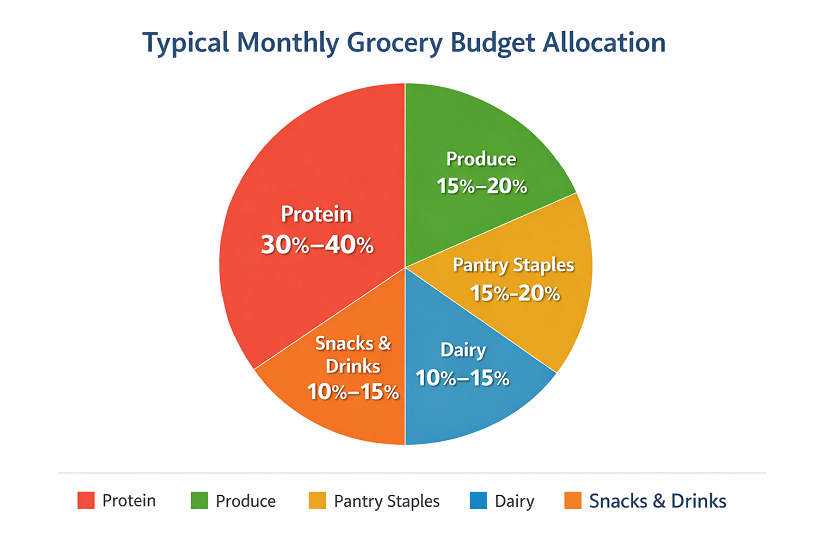
Families overspend when they either underestimate food costs or attempt unrealistic cuts. The goal is balance: affordability without constant strain.
Understand National Grocery Cost Benchmarks
Before setting your own number, you need context.
In the United States, moderate-cost grocery plans for a family of four typically fall between:
- Low-cost range: $800–$900 per month
- Moderate range: $900–$1,050 per month
- Higher range: $1,050–$1,200+ per month
These ranges assume:
- Most meals eaten at home
- Balanced nutrition
- No extreme specialty diets
If your spending is far above this range, inefficiencies likely exist.
If it is far below, sustainability may be an issue.
Grocery Budget Estimates by Family Size
Here is a simplified benchmark framework:
Family of 2
- Low-cost: $400–$550
- Moderate: $550–$700
Family of 3
- Low-cost: $600–$750
- Moderate: $750–$900
Family of 4
- Low-cost: $800–$900
- Moderate: $900–$1,050
Family of 5
- Low-cost: $950–$1,100
- Moderate: $1,100–$1,300
These numbers vary by region and inflation.
Urban areas and high-cost states trend higher.
The purpose of benchmarks is awareness, not comparison.
Calculate Your Personalized Grocery Budget
A realistic grocery budget should reflect your actual household pattern.
Use this formula:
Step 1: Identify net monthly income.
Step 2: Allocate 10–15% of take-home income to groceries.
Example:
Monthly take-home income: $6,000
12% grocery allocation: $720
Now compare that number to national benchmarks.
If your income supports $720 but benchmarks suggest $900 for your family size, adjustments are needed in one of two areas:
- Increase efficiency
- Adjust expectations
Budgeting is alignment, not denial.
Factor in Inflation and Regional Price Differences
Grocery inflation changes budgets quickly.
If food prices rise 5–10% year-over-year, your budget must adapt.
Example:
If your 2024 grocery budget was $900
8% inflation increases it to $972
Ignoring inflation leads to perceived “overspending” when in reality prices have shifted.
Track:
- Cost per pound of chicken
- Cost per dozen eggs
- Cost per gallon of milk
If staple items rise consistently, budget adjustments are rational—not failure.
Separate Groceries From Other Food Spending
Many families miscalculate grocery budgets because they mix categories.
Groceries include:
- Supermarket purchases
- Warehouse club food
- Household staples purchased at grocery stores
Groceries do not include:
- Restaurants
- Coffee shops
- Fast food
- School lunches
If dining out is mixed into grocery totals, the number becomes distorted.
Separate them clearly.
Define Budget Tiers: Survival, Controlled, and Comfortable
Every family operates within a different tier.
Survival Budget
- Focus on staples
- Limited convenience foods
- Heavy meal repetition
- Strict snack control
Typical cost: lower benchmark range
Controlled Budget
- Balanced nutrition
- Moderate flexibility
- Occasional convenience
Typical cost: mid-range
Comfortable Budget
- Specialty items
- Higher meat consumption
- Organic preference
- Greater variety
Typical cost: upper benchmark range
There is no universal “correct” tier.
There is only alignment with financial goals.
Adjust Grocery Budgets Based on Meal Frequency at Home
If your family eats:
- 21 meals per week at home → higher grocery budget required
- 14 meals per week at home → lower grocery budget
Example:
Family of four eating all meals at home may need $1,000+ per month.
If two dinners per week are outside the home, grocery budget may drop by $120–$200.
Meal frequency directly affects grocery planning.
Identify Red Flags That Your Grocery Budget Is Unrealistic
A grocery budget may be too low if:
- You consistently overspend every week
- You rely heavily on takeout
- Meals lack adequate protein or produce
- Stress around shopping is constant
A grocery budget may be too high if:
- Food waste exceeds 10%
- Impulse purchases are frequent
- Snacks and drinks dominate spending
A realistic grocery budget supports nutrition and consistency.
The Goal of a Realistic Grocery Budget
The goal is not the lowest number possible.
The goal is:
- Predictability
- Nutritional adequacy
- Reduced financial stress
- Monthly stability
Families who define a realistic grocery budget early avoid constant resets.
Once the number is defined, optimization becomes easier.
Budget clarity is the foundation for saving money on groceries long term.
How Do You Grocery Shop on a Tight Budget?
To grocery shop on a tight budget, families must prioritize essential meals first, base their plan on low-cost staples, reduce protein portion sizes, eliminate high-markup convenience foods, shop once per week with a strict spending cap, and calculate cost per meal. Structured decision-making protects limited grocery funds.
Shopping on a tight budget is not about deprivation.
It is about maximizing value per dollar.
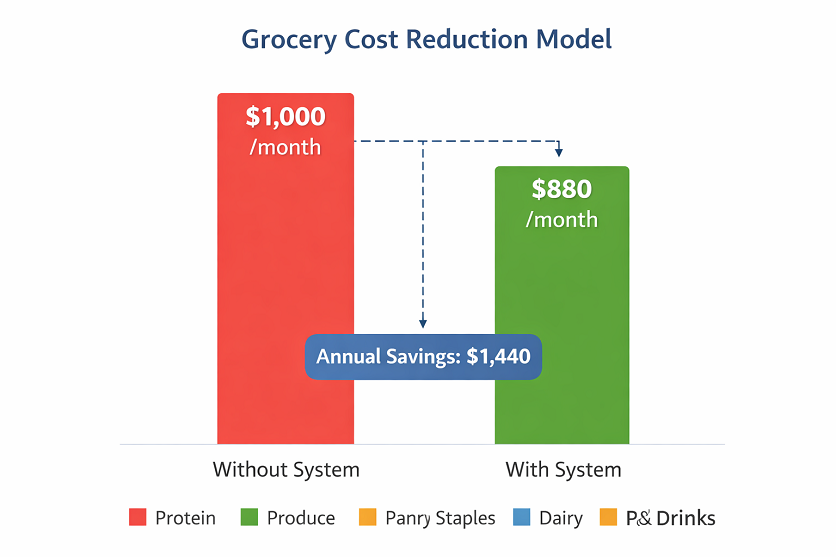
When funds are limited, efficiency matters more than variety.
Prioritize Essential Meals Before Optional Purchases
When grocery money is tight, secure calories and nutrition first.
Start with the number of meals required.
Example:
Family of four
21 core meals per week (7 breakfasts, 7 lunches, 7 dinners)
If your weekly grocery budget is $160:
$160 ÷ 21 meals = $7.62 per family meal
Per serving: $1.90
This is your cost ceiling.
Snacks and extras must fit after meals are fully covered.
Build a “Meal Coverage List” Before Entering the Store
Before shopping, write:
- 7 dinners
- 5–7 lunches
- 5–7 breakfasts
Every item in your cart must attach to one of those meals.
If it does not attach to a meal, it does not belong in the cart.
This single filter can reduce impulse spending by 10–20%.
Anchor Your Budget Around Low-Cost Staple Foods
Staples provide the highest calorie and satiety return per dollar.
Examples of cost efficiency:
- 20 lb rice bag: often under $1 per pound
- Dried beans: often under $1.50 per pound
- Oats: under $0.25 per serving
- Potatoes: often under $0.70 per pound
Compare that to:
- Snack bags: $4–$6 for minimal satiety
- Frozen convenience meals: $4–$8 per serving
Staples reduce cost per serving dramatically.
Design Meals Using the 3-Part Budget Formula
Every tight-budget meal should include:
- Base (rice, pasta, potatoes)
- Protein (beans, eggs, small meat portion)
- Vegetable (frozen or seasonal produce)
Example low-cost dinner:
- Rice: $0.50
- Beans: $1.20
- Frozen vegetables: $1.50
- Seasoning: $0.30
Total: $3.50 for entire meal
Family of 4: $0.87 per serving
Structure reduces overspending.
Reduce Protein Costs Without Eliminating Protein
Protein is typically 30–40% of a grocery bill.
Reducing portion size produces large savings.
Example:
Ground beef $5.50 per pound
Using 2 pounds weekly = $11
Reduce to 1.5 pounds weekly = $8.25
Weekly savings: $2.75
Annual savings: $143
Stretch protein by:
- Mixing beans with meat
- Adding lentils to soups
- Using eggs as protein replacements
Protein reduction is leverage.
Shop Once Per Week With a Strict Spending Cap
More trips equal more spending.
If a family makes:
- 2 extra quick trips per week
- Average $25 per trip
That equals:
$50 weekly
$2,600 annually
Tight budgets require controlled exposure.
Use a Hard Checkout Rule
Before checkout:
- Review cart total
- Compare to weekly cap
If over budget:
Remove items in this order:
- Snacks
- Drinks
- Convenience foods
- Secondary proteins
Never remove staple meal components first.
Hierarchy protects nutrition.
Eliminate High-Markup Categories Immediately
When grocery shopping on a tight budget, certain categories must shrink.
High-margin categories include:
- Individual snack packs
- Bottled beverages
- Pre-cut fruit
- Ready-made deli meals
Example:
Pre-cut fruit tray: $6
Whole fruit equivalent: $3
Savings per purchase: $3
Weekly savings: $12
Annual savings: $624
Convenience is expensive.
Compare Unit Prices, Not Shelf Prices
Shelf prices mislead. Unit prices reveal truth.
Example:
Cereal A: $4.99 (18 oz)
Cereal B: $5.49 (24 oz)
Unit price comparison may show Cereal B is cheaper per ounce.
On a tight budget, buying the better unit value reduces cumulative cost.
Unit price awareness can reduce grocery spending by 5–8% without reducing quantity.
Plan Around Sales Strategically
Sales can help tight budgets—but only when planned.
If chicken is discounted 25%, adjust meals around chicken that week.
If pasta is discounted 30%, increase pasta rotation temporarily.
Do not buy sale items that have no meal assignment.
Discount without plan equals delayed waste.
Track Spending and Adjust Weekly
Tight-budget grocery shopping is iterative.
After each week:
- Record total spend
- Calculate cost per meal
- Identify high-cost categories
Example:
Weekly spend: $170
21 meals
Cost per family meal: $8.09
If goal was $7.50, identify where $0.59 per meal increased.
Small weekly adjustments prevent monthly failure.
The Tight Budget Discipline Framework
Families who consistently grocery shop on a tight budget:
- Calculate cost per meal before shopping.
- Build meals around staples.
- Reduce protein portions strategically.
- Eliminate high-markup items first.
- Shop once per week with a strict cap.
- Review spending weekly.
They do not depend on extreme couponing.
They depend on math and structure.
Tight budgets reward precision.
What Grocery Shopping Mistakes Cost Families the Most Money?
The grocery shopping mistakes that cost families the most money include shopping without a defined plan, making multiple weekly store visits, overbuying perishables, purchasing high-markup convenience items, ignoring unit pricing, and shopping under emotional stress. These repeated behavioral errors can increase annual grocery spending by $1,500–$4,000.
Most grocery overspending is not intentional.
It is behavioral.
Families rarely overspend because of one expensive item.
They overspend because of predictable psychological triggers.
Behavioral Trigger #1: Decision Fatigue
The average grocery store carries 30,000–40,000 items.
Every choice drains mental energy.
When decision fatigue increases:
- Price comparison decreases
- Impulse buying increases
- Convenience purchases rise
If decision fatigue causes just 2 extra impulse items per trip at $5 each:
$10 per trip
$520 annually
Reducing decisions reduces spending.
Error Model: Unstructured Shopping
Unstructured shopping increases cognitive load.
Without a meal plan:
- You evaluate more items
- You consider more options
- You make more micro-decisions
More decisions = more spending leaks.
Solution:
Pre-decide meals before entering the store.
Behavioral Trigger #2: Scarcity Fear
When items appear limited or “on sale,” urgency increases.
Scarcity bias causes:
- Overbuying
- Duplicate purchasing
- Bulk without planning
Example:
Buy 3 extra “discounted” items at $8 each without plan.
$24 extra
If repeated twice monthly:
$576 annually
Sales without assignment increase waste.
Error Model: False Savings Illusion
Families often calculate savings incorrectly.
Example:
“Buy 2, save $3.”
If you did not need two, you did not save $3.
You spent more.
True savings only occur when:
- The item was planned
- The item will be consumed
- The discount lowers cost per serving
Behavioral Trigger #3: Emotional State Spending
Shopping while hungry, rushed, or stressed increases high-calorie and high-convenience purchases.
Emotional shopping typically raises spending 5–12%.
Example:
Weekly grocery budget: $220
8% emotional increase: $17.60
Annual impact: $915
Emotional states have measurable financial cost.
Error Model: Stress-Driven Convenience Premium
Convenience foods often cost 2–3× more per serving than homemade equivalents.
Example:
Frozen dinner: $6 per serving
Homemade dinner: $2.75 per serving
Difference: $3.25
Used 4 times weekly:
$13 weekly
$676 annually
Stress amplifies this premium.
Behavioral Trigger #4: Inventory Blindness
Most families do not track what they already own.
This creates:
- Duplicate purchases
- Expired products
- Forgotten leftovers
If 10% of groceries go unused:
Monthly grocery bill: $900
Waste: $90
Annual waste: $1,080
Inventory awareness directly reduces loss.
Error Model: Duplicate Buying Loop
Without inventory checks:
- Pasta bought while 3 boxes already exist
- Sauce bought while 2 jars unopened
- Snacks bought while previous pack unfinished
Each duplicate may only cost $3–$5.
Stacked weekly, this can exceed $600–$1,000 annually.
Small repetition drives large leakage.
Behavioral Trigger #5: Exposure Frequency
The more often you enter a grocery store, the more likely you are to spend.
Exposure multiplies temptation.
Example:
Primary weekly shop: $200
Two small midweek trips: $28 each
$56 weekly extra
$2,912 annually
The cost of convenience trips is rarely calculated.
Error Model: Compounding Micro-Spend
Assume weekly:
- $15 impulse snacks
- $20 quick-trip spending
- $20 food waste
$55 weekly leakage
$2,860 annually
Over five years:
$14,300
Micro-spending compounds faster than families realize.
Behavioral Trigger #6: Aspirational Shopping
Many families shop for ideal eating habits instead of real ones.
They buy:
- Complex recipe ingredients
- Excess fresh produce
- Specialty health items
If 20% of these aspirational purchases go unused:
$40 weekly ideal spending
$8 wasted
$416 annually
Buy according to behavior, not aspiration.
Behavioral Trigger #7: Unit Price Neglect
Ignoring price per ounce or pound creates silent overspending.
Example:
15 items per week purchased at $0.25 higher unit cost
$3.75 weekly
$195 annually
Unit price awareness is a low-effort correction with measurable impact.
Advanced Error Stack: Combined Impact Scenario
Let’s model a realistic middle-class family:
- $20 weekly food waste
- $30 weekly quick trips
- $15 weekly impulse snacks
- $10 weekly convenience upgrades
Total weekly leakage: $75
Annual impact:
$75 × 52 = $3,900
This is the cost of unstructured grocery behavior.
Most families do not need extreme budgeting tactics.
They need error reduction.
How High-Saving Families Avoid These Mistakes
Families who consistently save money on groceries:
- Plan meals before shopping.
- Check inventory weekly.
- Limit grocery exposure to once per week.
- Track cost per meal.
- Avoid emotionally driven purchases.
- Evaluate sales against real needs.
They eliminate predictable errors first.
Savings come from discipline, not deprivation.
What Are the Cheapest Grocery Stores for Families?
The cheapest grocery stores for families are those with consistently low unit prices, strong private-label options, and predictable staple discounts. Aldi, Walmart, and warehouse clubs like Costco and Sam’s Club typically offer the lowest overall grocery costs when used strategically and compared by price per pound, ounce, or serving.
The cheapest store is not the one with the lowest shelf price.
It is the one with the lowest usable unit cost.
How Do You Objectively Compare Grocery Store Prices?
To identify the cheapest grocery store for your family, compare unit prices (price per pound or ounce), calculate cost per serving, and factor in waste and membership fees. Shelf price alone is misleading and often hides higher per-unit costs.
Unit price is the only reliable comparison metric.
Example: Rice Cost Comparison
| Store | Package Size | Shelf Price | Price Per Pound |
|---|---|---|---|
| Aldi | 5 lb | $4.95 | $0.99 |
| Walmart | 5 lb | $5.49 | $1.09 |
| Warehouse Club | 20 lb | $16.80 | $0.84 |
If your family consumes 10 pounds of rice per month:
- Aldi annual cost: $118.80
- Walmart annual cost: $130.80
- Warehouse annual cost: $100.80
Difference between Aldi and Warehouse: $18 per year
Difference between Walmart and Warehouse: $30 per year
Multiply this across 10 staple items, and annual savings can exceed $300–$500.
Aldi: Lowest Baseline for Staple Foods
Aldi consistently ranks among the cheapest grocery stores for families due to its limited selection and heavy private-label model.
Why Aldi Is Often Cheapest
- 90%+ private-label inventory
- Limited SKUs (lower operational cost)
- Minimal store layout
- Lower staffing model
Cost Advantage Example
Eggs comparison (example average pricing):
- Aldi: $1.49 per dozen
- Walmart: $1.69 per dozen
- Traditional supermarket: $2.29 per dozen
If your family buys 4 dozen per month:
Aldi vs supermarket savings:
$0.80 × 4 = $3.20 monthly
$38.40 annually
Small categories compound.
Walmart: Strong for Brand and Hybrid Shopping
Walmart operates on an Everyday Low Price (EDLP) model.
Where Walmart Wins
- National brands priced 10–20% lower than traditional grocers
- Larger product range than Aldi
- Competitive pricing on mid-size family packs
Example: Cereal
Brand cereal:
- Supermarket: $5.99
- Walmart: $4.79
Difference: $1.20 per box
If purchased weekly:
$62 annually saved
Walmart becomes cost-effective when:
- You buy some branded items
- Aldi lacks needed items
- You combine grocery + household trips
Warehouse Clubs: Bulk Math Must Justify Membership
Warehouse clubs often offer the lowest unit price—but only when volume matches consumption.
Example: Chicken Breast
| Store | Package Size | Shelf Price | Price Per Pound |
|---|---|---|---|
| Aldi | 3 lb | $8.97 | $2.99 |
| Walmart | 5 lb | $14.95 | $2.99 |
| Warehouse | 10 lb | $24.90 | $2.49 |
Savings per pound at warehouse: $0.50
If your family consumes 8 pounds per month:
Monthly savings: $4
Annual savings: $48
Multiply across multiple bulk staples:
- Rice
- Beans
- Cheese
- Oats
- Flour
Annual bulk savings can reach $300–$600.
Membership Break-Even Model
Warehouse membership fee: $60 annually
If average monthly savings = $35
Break-even achieved in less than 2 months.
But only if:
- Food is fully consumed
- Waste remains low
- You avoid impulse bulk buys
Bulk without discipline erodes savings.
The Hidden Cost of Shopping at Traditional Supermarkets
Traditional supermarkets often:
- Carry higher overhead
- Offer more premium brands
- Promote impulse buying heavily
Example markup comparison:
Pasta:
- Traditional store: $1.89
- Aldi: $1.19
Difference: $0.70
If buying 4 boxes per month:
$2.80 monthly
$33.60 annually
Across 20 staple items, markup may exceed $500–$1,000 annually.
Convenience and proximity often justify higher prices—but at measurable cost.
How to Build a Cheapest Store Strategy
The cheapest grocery strategy for families often combines stores.
Sample Hybrid Strategy (Family of 4, $900/month budget)
- Aldi: $500 (staples + basics)
- Warehouse Club: $250 (bulk proteins + pantry)
- Walmart: $150 (brands + fill-ins)
Optimized unit pricing reduces effective monthly spend by 5–15%.
On a $900 budget:
10% efficiency gain = $90 monthly
$1,080 annually
Store strategy alone can equal a full month of groceries saved each year.
Cheapest Store by Category
Instead of asking “Which store is cheapest?”, ask:
Which store is cheapest for this category?
Typical patterns:
- Rice, pasta, canned goods → Aldi or warehouse
- Bulk meat → warehouse
- Branded snacks → Walmart
- Dairy → Aldi
- Household staples → Walmart or warehouse
Category optimization outperforms store loyalty.
Exposure Risk in Cheap Stores
Even low-price stores can trigger overspending.
Cheap shelf prices increase “stock-up psychology.”
If low prices cause:
- $40 unplanned purchases weekly
- $2,080 annually
The savings disappear.
Discipline matters more than store choice.
The Real Definition of “Cheapest Grocery Store”
The cheapest grocery store for your family is the one that:
- Offers the lowest unit price on staple items.
- Minimizes impulse triggers.
- Matches your consumption rate.
- Does not increase food waste.
- Fits within your travel and time constraints.
Savings must be net of:
- Membership fees
- Fuel cost
- Extra trips
- Waste
Unit price minus waste equals true savings.
How Can Families Save Money on Meat and Protein?
Families can save money on meat and protein by reducing portion sizes, buying in bulk when unit prices are lower, choosing lower-cost protein sources, stretching meat across multiple meals, and rotating meatless dinners weekly. Because protein often accounts for 30–40% of grocery spending, small adjustments can reduce annual costs by $500–$1,500.
Protein is the highest-leverage grocery category.
If you control protein spending, you control the grocery budget.
Understand How Much Protein Really Costs Your Family
Before cutting anything, calculate the impact.
If your monthly grocery budget is $900 and protein represents 35%:
$900 × 35% = $315 per month on protein
Annual protein spending: $3,780
Reducing protein costs by just 10% saves:
$31.50 per month
$378 per year
Small percentage changes produce large annual savings.
Reduce Portion Size Without Reducing Nutrition
Most families over-serve meat.
Recommended cooked portion per adult:
3–4 ounces per meal
Many families serve 6–8 ounces.
Example:
Ground beef: $5.50 per pound
If you serve:
8 oz per person (½ lb) for family of 4
You use 2 pounds = $11 per meal
If you serve:
4 oz per person
You use 1 pound = $5.50 per meal
Savings per meal: $5.50
If repeated twice weekly:
$11 weekly
$572 annually
Portion control alone can cut protein costs by 20–30%.
Stretch Meat Across Multiple Meals
Instead of treating meat as the center of the plate, treat it as an ingredient.
Example:
3-pound pack of chicken ($2.99/lb)
Total cost: $8.97
Instead of one large chicken-heavy meal:
Divide into:
- Chicken tacos
- Chicken soup
- Chicken fried rice
Three meals from one pack.
Cost per meal: $2.99
Stretching reduces cost per serving dramatically.
Combine Meat With Lower-Cost Proteins
Blending reduces total meat usage without eliminating protein.
Examples:
- 50% ground beef + 50% lentils
- Chicken + black beans
- Turkey + rice + beans
- Chili with half meat, half legumes
If a recipe normally uses 2 pounds of meat:
Replace 1 pound with beans costing $1.50
Savings per recipe:
$5.50 – $1.50 = $4
If used weekly:
$208 annually
Blending preserves flavor while lowering cost.
Rotate Meatless Meals Weekly
You do not need to eliminate meat.
One or two meatless dinners per week can significantly reduce spending.
Example:
If average meat-based dinner costs $10 in protein
Plant-based dinner costs $4 in protein
Savings per meal: $6
Two times per week:
$12 weekly
$624 annually
Protein diversity increases savings.
Buy Meat Based on Price Per Pound, Not Preference
Always set “never pay above” thresholds.
Example targets (varies by region):
- Chicken breast: under $3 per pound
- Ground beef: under $5 per pound
- Pork shoulder: under $2.50 per pound
If prices exceed your threshold, substitute.
Substitution prevents emotional overpaying.
Buy Family Packs Only When Fully Used
Bulk meat can reduce cost per pound—but only if used.
Example:
Regular pack: $3.29 per pound
Family pack: $2.79 per pound
Savings: $0.50 per pound
If you buy 10 pounds:
$5 saved
But if 2 pounds spoil:
2 × $2.79 = $5.58 wasted
Net loss.
Bulk savings require:
- Immediate portioning
- Freezer storage
- Clear usage plan
Freeze Strategically to Lock in Low Prices
When meat is discounted:
Buy at lower price and freeze.
Example:
Chicken normally $3.49/lb
Sale price $2.49/lb
Savings per pound: $1
Buy 8 pounds during sale:
$8 saved immediately
If done monthly:
$96 annually
Freezing converts temporary discounts into long-term savings.
Compare Protein Cost Per Serving
Instead of comparing cost per pound, compare cost per serving.
Example:
Chicken breast at $3 per pound
1 pound ≈ 4 servings
Cost per serving: $0.75
Eggs at $2 per dozen
12 servings
Cost per serving: $0.17
Lentils at $1.50 per pound
≈ 6–8 servings
Cost per serving: ~$0.20–$0.25
Cost-per-serving comparison often reveals better value options.
Eggs and legumes frequently deliver the cheapest protein per serving.
Avoid Premium Cuts for Everyday Meals
Steak, specialty cuts, and pre-marinated meats carry markup.
Example:
Pre-marinated chicken: $6.99 per pound
Plain chicken: $2.99 per pound
Difference: $4 per pound
For 2 pounds:
$8 extra
Seasoning at home costs under $1.
Convenience protein multiplies cost.
Track Weekly Protein Spend
If your weekly grocery budget is $225:
Protein should ideally remain under 30–35%.
$225 × 35% = $78.75
If protein spending reaches $95:
You are overspending by $16 weekly
$832 annually
Tracking prevents silent drift.
Advanced Protein Savings Model
Let’s model moderate adjustments:
- Portion reduction: $10 weekly
- One meatless meal: $6 weekly
- Blended protein meals: $4 weekly
Total weekly savings: $20
$20 × 52 = $1,040 annually
Most families can reduce protein costs by $800–$1,200 per year without sacrificing nutrition.
Protein control is the highest-impact grocery strategy.
What Families Who Control Protein Spending Do Differently
They:
- Measure portion sizes.
- Compare cost per serving.
- Blend meat with lower-cost proteins.
- Freeze meat purchased at discount.
- Rotate meatless meals weekly.
They do not eliminate protein.
They optimize it.
Controlling protein spending alone can reduce total grocery costs by 10–15%.
How Do Families Reduce Food Waste and Stretch Groceries Further?
Families reduce food waste and stretch groceries further by planning meals around existing inventory, storing food correctly, scheduling weekly “use-it-up” meals, freezing excess portions immediately, and tracking waste patterns. Because 10–20% of groceries are typically wasted, reducing food waste can save $800–$1,500 per year without cutting food quality.
Food waste is silent overspending.
You already paid for the food.
Throwing it away is a 100% loss.
Understand the Real Cost of Food Waste
Most families underestimate how much they waste.
Conservative estimate:
If your grocery budget is $900 per month
10% waste = $90 per month
Annual loss = $1,080
At 15% waste:
$135 per month
$1,620 annually
Food waste reduction is one of the fastest ways to save money on groceries without changing what you eat.
Conduct a 14-Day Waste Audit
You cannot fix what you do not measure.
For two weeks, track:
- Food thrown away
- Expired items
- Uneaten leftovers
- Spoiled produce
Common repeat offenders:
- Bagged salad
- Fresh herbs
- Leftover pasta
- Bulk fruit
If you identify $25 in weekly waste:
$25 × 52 = $1,300 annually
Awareness creates correction.
Plan Meals Around Inventory First
Before writing a grocery list:
- Check pantry
- Check refrigerator
- Check freezer
- Create a “use first” list
Inventory-first planning reduces duplicate buying and prevents expiration.
Example:
If you already have:
- 2 boxes of pasta
- 1 jar of sauce
- Frozen vegetables
That is one dinner already covered.
Using inventory reduces new purchases automatically.
Implement a Weekly “Use-It-Up” Meal
Schedule one dedicated meal per week for leftovers or near-expiration ingredients.
Effective formats:
- Soup
- Stir fry
- Fried rice
- Casserole
- Wraps
Example savings:
If leftovers valued at $18 are used instead of discarded weekly:
$18 × 52 = $936 annually
Planned reuse turns waste into savings.
Freeze Early, Not Late
Many families freeze food too late—after quality has declined.
Freeze:
- Extra cooked meals
- Bread
- Meat purchased on sale
- Chopped vegetables
- Leftover rice
Example:
Cook 4 pounds of chicken instead of 2.
Use half immediately.
Freeze half for next week.
Avoids emergency grocery runs.
Emergency runs often cost $30–$50.
Freezing prevents unplanned spending.
Store Food for Maximum Shelf Life
Improper storage accelerates spoilage.
Examples:
- Store herbs in water like flowers.
- Keep potatoes in cool, dark areas.
- Separate bananas from other fruit.
- Use airtight containers for grains.
Extending produce life by even 3–4 days increases consumption probability.
Longer shelf life reduces waste risk.
Buy Perishables in Realistic Quantities
Bulk produce is only cheaper if fully consumed.
Example:
Large spinach container: $5
Small spinach bag: $3
If 40% of large container spoils:
$2 lost
Effective cost = $7 for usable portion
Smaller quantities may cost more per ounce but reduce total loss.
Total cost matters more than unit cost when spoilage risk is high.
Understand the Expiration Date Myth
Many dates on packaging indicate quality, not safety.
“Best by” does not mean “must discard.”
Learning to evaluate food by:
- Smell
- Texture
- Appearance
reduces premature disposal.
Throwing away safe food increases grocery costs unnecessarily.
Repurpose Leftovers Strategically
Leftovers fail when they lack purpose.
Convert leftovers into new meals:
- Roasted vegetables → omelets
- Chicken → wraps or soup
- Rice → fried rice
- Taco meat → stuffed peppers
Transformation reduces “leftover fatigue.”
If leftovers are reused twice weekly:
Estimated savings: $15–$25 weekly
Annual impact: $780–$1,300
Stretching food increases return on each grocery dollar.
Control Refrigerator Visibility
Food that is unseen is uneaten.
Strategies:
- Keep leftovers at eye level
- Use clear containers
- Label containers with dates
- Rotate older food forward
Visibility increases usage rate.
Reduced forgetfulness reduces waste.
Stretch Meals With Low-Cost Fillers
If a meal serves four but feels small, add:
- Rice
- Beans
- Potatoes
- Bread
Example:
Soup serving 4 people
Add rice or bread → serves 6
Extra 2 servings from $1 worth of starch
Cost per serving drops significantly.
Stretching reduces next-day grocery demand.
Waste Reduction Compounding Model
Let’s model moderate improvements:
- Reduce waste by $15 weekly
- Eliminate one emergency grocery trip monthly ($40)
- Repurpose leftovers twice weekly ($10 weekly value)
Weekly savings equivalent: $25
Plus monthly avoided trip: $40
Annual impact:
($25 × 52) + ($40 × 12)
= $1,300 + $480
= $1,780
Food waste control can rival protein savings in impact.
What Families Who Minimize Food Waste Do Differently
They:
- Audit waste regularly.
- Plan meals around inventory.
- Freeze excess immediately.
- Repurpose leftovers intentionally.
- Buy perishables realistically.
- Track monthly waste cost.
They treat food like money—because it is.
Stretching groceries further does not require extreme restriction.
It requires visibility, structure, and small weekly corrections.
What Pantry Staples Save the Most Money Long Term?
The pantry staples that save the most money long term are low-cost, shelf-stable foods that serve multiple meals, reduce emergency grocery trips, and lower cost per serving. Items like rice, beans, pasta, oats, canned tomatoes, flour, and frozen vegetables consistently deliver the highest nutritional value per dollar and reduce overall grocery volatility.
A strong pantry is financial infrastructure.
When pantry basics are stocked, families avoid expensive last-minute shopping.
Why Pantry Staples Reduce Grocery Costs
Pantry staples create three advantages:
- Lower cost per serving
- Fewer emergency grocery runs
- More meal flexibility
If one emergency grocery trip costs $35 and happens twice monthly:
$70 monthly
$840 annually
A stocked pantry prevents reactive spending.
High-Impact Pantry Staples and Their Cost Efficiency
Below are staple foods with strong long-term savings potential.
Rice
Average price: $0.80–$1.20 per pound (bulk pricing lower)
1 pound = roughly 10 servings
Cost per serving: $0.08–$0.12
Rice supports:
- Stir fry
- Burrito bowls
- Soup
- Casseroles
Low cost, high flexibility.
Dried Beans and Lentils
Average price: $1.25–$1.75 per pound
1 pound = 6–8 servings
Cost per serving: ~$0.20
Beans can:
- Replace meat
- Stretch ground beef
- Anchor soups
- Add protein cheaply
Replacing 1 pound of ground beef ($5.50) with beans ($1.50):
Savings: $4 per meal
Used weekly = $208 annually
Pasta
Average price: $1–$1.50 per pound
1 pound = 6–8 servings
Cost per serving: ~$0.15–$0.25
Pasta provides:
- High satiety
- Easy pairing with low-cost sauces
- Multiple meal variations
Bulk buying reduces per-unit cost further.
Oats
Average price: $3–$5 for large container
Cost per serving: ~$0.20
Compared to boxed cereal at $0.60–$1 per serving:
Savings per breakfast: $0.40
If family of four eats oats 3 times weekly:
$4.80 weekly savings
$250 annually
Breakfast is leverage.
Canned Tomatoes and Tomato Paste
Low cost, high versatility.
Used in:
- Pasta sauces
- Chili
- Soups
- Stews
Having base ingredients prevents purchasing pre-made sauces priced 2–3× higher.
Example:
Jarred sauce: $4.50
Homemade from canned tomatoes: ~$1.50
Savings per use: $3
Flour and Baking Basics
Flour, baking powder, sugar, yeast.
Allows making:
- Bread
- Pancakes
- Muffins
- Pizza dough
Homemade pizza:
Dough cost: under $1
Pre-made frozen pizza: $6–$10
Savings per pizza night: $5–$9
Used twice monthly = $120–$216 annually
Frozen Vegetables
Often cheaper per pound than fresh and last longer.
Average cost: $1–$2 per bag
Zero spoilage risk.
If fresh produce waste costs $15 weekly and frozen cuts waste by half:
$7.50 weekly saved
$390 annually
Shelf life matters.
Build a 30-Day Pantry Stability Model
A financially stable pantry supports at least:
- 10–14 dinners
- 7 breakfasts
- 5–7 lunches
Using mostly staples.
Example low-cost dinner built from pantry:
Rice + canned beans + frozen vegetables
Total cost: $3–$4 for family of four
Cost per serving: under $1
Emergency-proof meals reduce spending spikes.
Calculate Pantry ROI (Return on Inventory)
Example:
Spend $150 building staple pantry stock.
If pantry prevents:
- Two emergency grocery runs ($70)
- Three takeout nights ($120)
Total avoided spending: $190
Net gain: $40 immediately
Pantry staples function like savings insurance.
Overlapping Pantry Ingredients Increase Efficiency
Efficiency improves when staples work across multiple meals.
Example overlap:
Rice used in:
- Stir fry
- Burrito bowls
- Soup thickener
Canned tomatoes used in:
- Chili
- Pasta
- Curry
The more meals each item supports, the lower effective cost per meal.
Fragmented ingredients increase waste risk.
Avoid Pantry Bloat
Not all shelf-stable food saves money.
Avoid:
- Novelty sauces
- Specialty grains rarely used
- Excess snack stockpiling
Unused pantry items represent tied-up cash.
Inventory discipline matters.
How Pantry Staples Reduce Grocery Price Volatility
Food prices fluctuate.
If meat prices spike:
Shift toward beans and lentils.
If produce prices spike:
Use frozen vegetables and canned alternatives.
Pantry flexibility protects monthly grocery budgets during inflation.
Long-Term Savings Model
Let’s model moderate pantry optimization:
- Replace 1 meat meal weekly with beans ($4 savings)
- Replace 3 cereal breakfasts with oats ($4 savings)
- Avoid 2 emergency grocery trips monthly ($70 saved)
Monthly savings:
$16 (protein swaps)
$16 (breakfast swaps)
$70 (emergency avoidance)
Total: $102 monthly
$1,224 annually
Pantry staples create predictable savings without reducing food quality.
What Families With Strong Pantries Do Differently
They:
- Keep core staples stocked consistently.
- Build meals around low-cost base ingredients.
- Replace convenience items with homemade options.
- Avoid unnecessary pantry variety.
- Track inventory to prevent duplication.
Pantry infrastructure reduces financial stress.
Long-term grocery savings begin with shelf stability.
How Should Families Plan Groceries Around Sales, Coupons, and Apps?
Families should plan groceries around sales, coupons, and apps only after setting a weekly budget and meal plan. The most effective strategy is to match discounts to pre-planned meals, stack digital coupons selectively, and focus on high-impact categories like protein and pantry staples. Discounts only save money when purchases are intentional.
Sales do not create savings.
Alignment creates savings.
Without structure, promotions increase spending.
Step 1: Plan Meals Before Checking Sales
Always build your weekly meal plan first.
List:
- 7 dinners
- 5–7 lunches
- 5–7 breakfasts
Then check store ads.
If chicken is discounted and fits two planned meals, adjust protein choice.
If pasta is on sale and supports multiple meals, rotate accordingly.
If a sale item does not connect to a planned meal, skip it.
Buying discounted food without assignment often leads to waste.
Example: Sale Alignment vs Sale Drift
Scenario A: No Plan
Buy “Buy 2, Get 1 Free” pasta sauce for $9 total.
Only one jar is needed.
Effective extra spending: $6
Scenario B: Planned Use
Three pasta meals already planned.
All jars used.
True savings realized.
Intent determines outcome.
Step 2: Focus on High-Impact Categories First
Not all discounts matter equally.
High-impact categories include:
- Meat and poultry
- Dairy
- Pantry staples
- Bulk grains
Low-impact categories:
- Candy
- Chips
- Specialty snacks
If ground beef is discounted by $1 per pound and you buy 5 pounds:
$5 immediate savings
If chips are discounted by $0.50 per bag and you buy 3 bags:
$1.50 saved
Prioritize discounts where spending is largest.
Step 3: Use Digital Coupons Strategically
Digital coupons can reduce grocery bills by 3–10% when used selectively.
Avoid downloading dozens of coupons.
Focus on items you already buy.
Example:
Weekly grocery total: $220
Digital coupon savings: $12
Annual savings:
$12 × 52 = $624
But only if items were planned purchases.
Coupons should reduce cost—not increase cart size.
Coupon Discipline Rule
Only use coupons for:
- Items already on your list.
- Staple foods consumed weekly.
- Bulk items with long shelf life.
Never buy an item simply because you have a coupon.
A $2 coupon on a $6 product still costs $4.
Step 4: Understand Grocery Sales Cycles
Many grocery items rotate on predictable cycles:
- Chicken and beef every 4–6 weeks
- Pasta and canned goods every 6–8 weeks
- Baking goods seasonally
- Frozen foods monthly
Tracking cycles allows strategic stocking.
Example:
Chicken regularly drops from $3.49/lb to $2.49/lb.
Savings per pound: $1
If you buy 10 pounds during sale:
$10 saved
Repeating quarterly:
$40 annually on chicken alone
Sales cycle awareness turns timing into savings.
Step 5: Stack Savings Carefully
Stacking combines:
- Sale price
- Store coupon
- Cashback app
Example:
Item normally $5
On sale for $4
$1 store coupon
$0.50 cashback
Final cost: $2.50
Total savings: $2.50
Stacking works best for non-perishables.
Stacking perishable items without usage planning increases spoilage risk.
Step 6: Avoid App Overload
Using too many apps increases cognitive load.
Decision fatigue reduces actual savings.
Best practice:
- Use store app
- Use one cashback app
- Ignore the rest
Time spent chasing minor discounts may exceed financial benefit.
If you spend 30 minutes weekly to save $3:
Effective hourly return: $6
Efficiency matters.
Step 7: Calculate Real Discount Value
Many promotions exaggerate savings.
Example:
“Save $5 when you spend $25.”
If you add $8 of unnecessary items to reach threshold:
Net savings may be negative.
True savings formula:
Discount value – cost of added unplanned items = real savings
Only spend to threshold if items were already planned.
Step 8: Protect Against Stockpiling Waste
Buying discounted perishables without a freeze plan increases waste.
Example:
Buy 6 packs of discounted chicken.
Use 3 before spoilage.
Effective cost doubles on unused portion.
Discounts do not matter if food is wasted.
Freeze immediately and label with date.
Annual Savings Model With Controlled Discount Use
Moderate, disciplined approach:
- $15 weekly sale optimization
- $10 weekly digital coupon savings
- $10 monthly bulk sale stocking
Weekly savings equivalent: $25
Monthly bulk equivalent: $10
Annual impact:
($25 × 52) + ($10 × 12)
= $1,300 + $120
= $1,420
Sales discipline can rival protein and waste savings.
What High-Saving Families Do Differently
They:
- Plan meals first.
- Check ads second.
- Target high-impact categories.
- Track sales cycles.
- Stack selectively.
- Avoid impulse couponing.
They do not chase every deal.
They filter deals through structure.
Discounts should reduce planned spending—not justify new spending.
How Can Families Keep Grocery Costs Consistent During Inflation?
Families can keep grocery costs consistent during inflation by tracking price changes on staple items, adjusting meal plans based on rising categories, increasing reliance on pantry staples, reducing waste, and setting flexible budget buffers. Stability during inflation comes from substitution, monitoring, and disciplined purchasing—not from hoping prices return to normal.
Inflation does not destroy grocery budgets.
Lack of adjustment does.
When prices rise 5–10%, families must respond strategically.
Track Price Changes on Core Staples
Inflation does not affect all categories equally.
Track 8–10 high-impact items:
- Chicken (per pound)
- Ground beef (per pound)
- Eggs (per dozen)
- Milk (per gallon)
- Rice (per pound)
- Bread (per loaf)
- Cooking oil
- Cheese
If chicken rises from $2.49/lb to $3.29/lb:
Increase: $0.80 per pound
If you buy 8 pounds monthly:
$6.40 additional monthly
$76.80 annually
Monitoring helps you respond early.
Adjust Meal Plans Based on Price Shifts
Inflation requires substitution.
If beef increases 12% and beans increase 3%:
Shift one beef meal to a bean-based meal.
Example:
Ground beef dinner protein cost: $8
Bean-based dinner protein cost: $2
Savings: $6 per meal
Two substitutions weekly:
$12 weekly
$624 annually
Flexibility offsets inflation.
Increase Reliance on Pantry Infrastructure
During inflation, pantry staples stabilize spending.
Rice, beans, oats, pasta, and canned goods fluctuate less than fresh meat.
If meat prices spike 15% but rice increases only 4%:
Rebalance meal ratios toward grain-based dishes.
Pantry-heavy meals reduce exposure to volatile categories.
Build an Inflation Buffer Into Your Budget
If grocery prices increase 8%, adjust budget realistically.
Example:
Previous grocery budget: $900
8% increase: $972
Trying to force $900 spending without adjustment increases stress and failure.
Build a 3–5% buffer above current average to absorb volatility.
Budget buffers prevent reactionary overspending.
Reduce Waste Aggressively During Price Surges
Inflation amplifies the cost of waste.
If monthly waste was $90 pre-inflation:
After 8% inflation, waste cost becomes $97
Annual difference: $84 lost purely from higher prices.
Reducing waste by 50% during inflation offsets price increases.
Waste control is inflation protection.
Use Cost-Per-Meal Tracking as an Inflation Shield
Instead of tracking total grocery spend alone, track cost per dinner.
Example pre-inflation:
$220 weekly
7 dinners
$31.43 per dinner
Post-inflation:
$240 weekly
$34.29 per dinner
Difference: $2.86 per dinner
Now adjust:
- Reduce protein portion slightly
- Increase grain volume
- Add one meatless meal
Target return to $32 per dinner.
Cost-per-meal tracking enables tactical correction.
Delay Lifestyle Inflation in Grocery Spending
As income rises, grocery spending often rises automatically.
This is lifestyle inflation.
Example:
Income increase of $500 monthly
Grocery budget increases from $900 to $1,050
Additional $150 monthly
$1,800 annually
Inflation is not the only driver of rising grocery costs.
Behavior is.
Maintain structured grocery budgets even as income grows.
Buy Strategically During Temporary Price Dips
Inflation is uneven.
When a staple drops below average price, buy slightly ahead.
Example:
Chicken drops from $3.29 to $2.49 per pound
Buy 10 pounds instead of 5:
Immediate savings: $8
Freezing stabilizes future weeks at lower cost.
Strategic stockpiling smooths inflation waves.
Separate Emotional Reaction From Economic Reality
Inflation creates urgency and fear.
Fear-driven stockpiling often increases waste.
Buying 6 extra perishable items “before prices rise” can cause spoilage.
If $40 of extra purchases spoil:
Inflation did not cause the loss—behavior did.
Calm planning protects budgets.
Long-Term Inflation Control Model
Let’s model moderate inflation management:
- Replace two meat meals weekly ($12 saved)
- Reduce waste by $10 weekly
- Buy $20 of discounted staples monthly
- Add 4% budget buffer instead of 8%
Weekly savings equivalent: $22
Monthly strategic savings: $20
Annual impact:
($22 × 52) + ($20 × 12)
= $1,144 + $240
= $1,384
Structured adjustment offsets most moderate inflation.
What Stable Families Do During Inflation
They:
- Track staple price changes.
- Substitute intelligently.
- Strengthen pantry reliance.
- Reduce waste further.
- Maintain discipline despite rising income.
- Avoid panic buying.
Inflation rewards flexibility.
Grocery budgets stay consistent when behavior adapts faster than prices rise.
Frequently Asked Questions About Saving Money on Groceries
How much should a family of four spend on groceries per month?
A realistic grocery budget for a family of four typically ranges between $800 and $1,200 per month, depending on location, dietary preferences, and how often meals are eaten at home. Families focused on cost control often stay within $900–$1,000 by planning meals, reducing waste, and managing protein spending.
What is the cheapest way to grocery shop?
The cheapest way to grocery shop is to plan meals before entering the store, shop once per week, buy staple foods like rice and beans, compare unit prices, and avoid high-markup convenience items. Structured planning reduces impulse purchases and keeps weekly grocery spending predictable.
How can families save money on groceries without using coupons?
Families can save money on groceries without coupons by reducing protein portions, buying store-brand items, limiting grocery trips, minimizing food waste, and tracking cost per meal. Behavioral adjustments often produce larger savings than coupon stacking alone.
How do I grocery shop on a $100 weekly budget?
To grocery shop on a $100 weekly budget, prioritize essential meals first, build meals around low-cost staples, reduce meat portions, avoid snacks and drinks, and compare unit prices carefully. Focus on cost per serving and eliminate impulse purchases to stay within the weekly cap.
What grocery items should families always buy in bulk?
Families should buy shelf-stable staples in bulk when unit prices are lower and consumption is consistent. Good bulk items include rice, beans, oats, pasta, canned goods, and frozen vegetables. Bulk meat can also save money if portioned and frozen immediately to prevent waste.
How much can families realistically save by reducing food waste?
Families can realistically save $800 to $1,500 per year by reducing food waste. Even cutting $20 per week in spoiled produce and unused leftovers results in over $1,000 in annual savings without changing overall grocery volume.
Is Aldi really cheaper than other grocery stores?
Aldi is often cheaper than traditional supermarkets because it relies heavily on private-label products and limited inventory. On staple items like dairy, pantry goods, and frozen vegetables, Aldi frequently beats competitors by 10–30%, though bulk warehouse clubs may offer lower unit prices on select items.
How do you keep grocery costs consistent during inflation?
To keep grocery costs consistent during inflation, track staple price changes, substitute lower-cost proteins when prices rise, strengthen pantry reliance, reduce waste aggressively, and build a small budget buffer. Flexibility and monitoring prevent sudden spending spikes.
What percentage of income should go toward groceries?
Most families spend between 10% and 15% of take-home income on groceries. Households cooking nearly all meals at home may fall toward the higher end, while families eating out frequently may spend less on groceries but more on overall food costs.
What is the fastest way to lower a grocery bill?
The fastest way to lower a grocery bill is to reduce meat portions, eliminate impulse snack purchases, shop once per week, and conduct a two-week food waste audit. These changes can reduce weekly grocery spending by $20–$50 almost immediately.
Conclusion: Saving Money on Groceries Is a System, Not a Trick
Saving money on groceries is not about extreme couponing, skipping meals, or chasing every discount. It is about structure.
Families who consistently lower grocery bills do five things well:
- They set a realistic monthly grocery budget.
- They plan meals before shopping.
- They control protein and high-impact categories.
- They reduce food waste aggressively.
- They track cost per meal and adjust weekly.
Grocery savings are predictable when systems are predictable.
Even small changes—like reducing food waste by $20 per week or trimming protein spending by 10%—can save $1,000 or more per year.
The goal is not to spend the least possible.
The goal is to spend intentionally and consistently.
When you control groceries, you control one of the largest flexible expenses in your household budget.
That is long-term financial leverage.