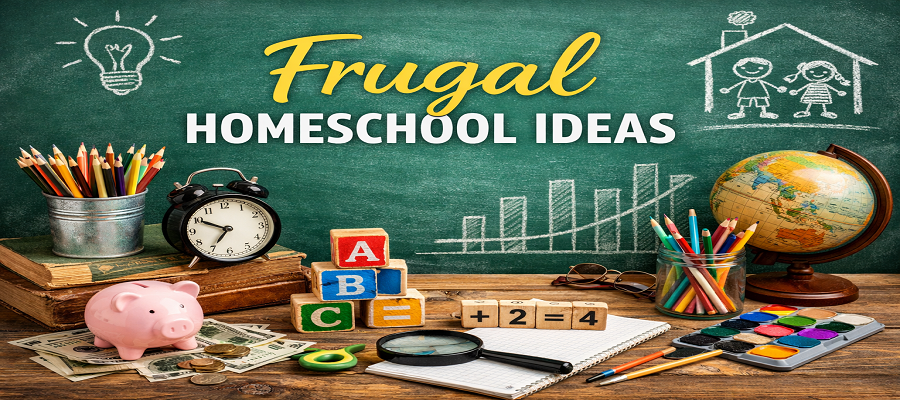
Frugal homeschool ideas help families teach their children without spending large amounts of money on curriculum, supplies, or learning tools. Many parents successfully homeschool using free curriculum, library resources, cheap learning materials, and simple DIY teaching tools.
Homeschooling does not require expensive programs to work well. With the right frugal homeschool ideas, families can build a full learning plan using free educational websites, affordable homeschool supplies, second-hand books, and community resources.
The key is knowing where to find the best cheap homeschool resources and how to combine them into a simple daily learning routine. From free homeschool curriculum and educational apps to library programs and DIY science projects, many effective options cost little or nothing.
Here you will discover 15 frugal homeschool ideas that actually save money while still helping children learn effectively at home.
These strategies fit perfectly within frugal living tips for families who want to reduce education costs.
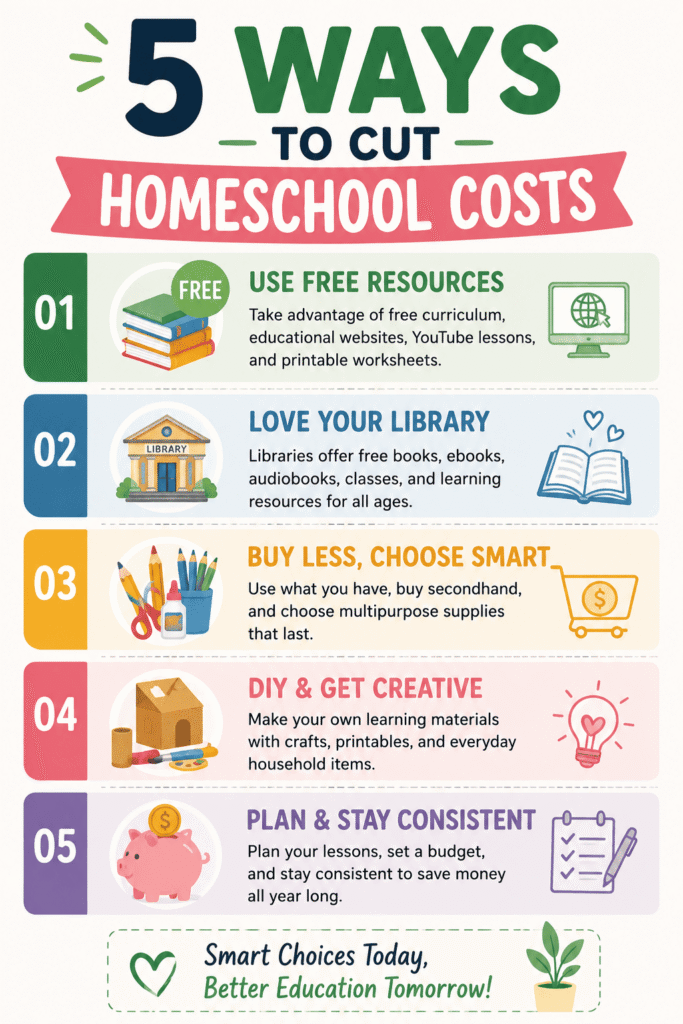
1. Use Free Homeschool Curriculum
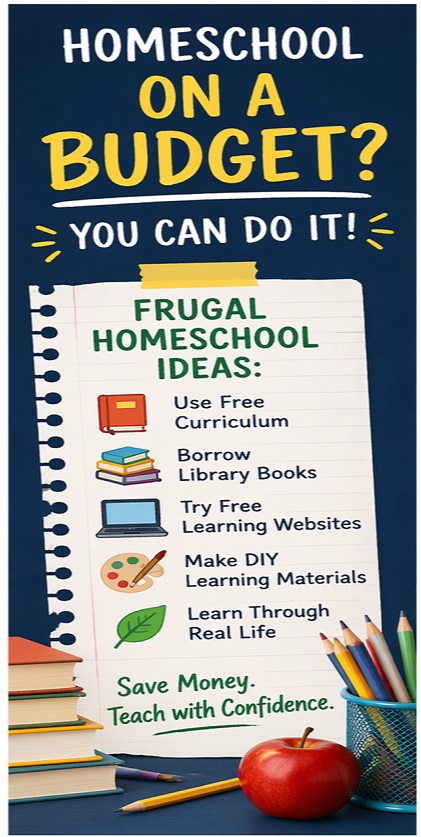
One of the best frugal homeschool ideas is using free homeschool curriculum instead of expensive programs. Many high-quality platforms provide full lessons, exercises, and learning plans at no cost.
Families can build a complete homeschool program using these resources.
Helpful options include:
- Khan Academy for math, science, and many other subjects
- Easy Peasy All-in-One Homeschool for full grade-level curriculum
- CK-12 for interactive textbooks and science lessons
- Ambleside Online for literature-based homeschooling
These programs allow families to teach core subjects without buying costly textbooks or workbooks.
Many homeschool parents combine several free resources to create a flexible learning system that fits their child’s pace and interests.
2. Turn Your Local Library Into a Learning Hub
Libraries are one of the most powerful frugal homeschool ideas many families overlook.
A library can replace large parts of a homeschool curriculum.
Libraries offer:
- Thousands of books for reading and literature studies
- Audiobooks for listening comprehension
- Documentaries and educational videos
- Research materials for history and science
- Free workshops and learning events
Instead of buying large book collections, families can rotate books weekly and explore new topics without spending money.
Many homeschool families plan entire learning units around library materials.
3. Buy Homeschool Supplies From Thrift Stores
Another practical frugal homeschool idea is buying second-hand learning materials.
Thrift stores and used bookstores often have:
- Children’s books
- Educational games
- Flashcards
- Puzzles
- Science kits
These items usually cost a fraction of the original price.
Used homeschool curriculum can also be found in local homeschool groups and online marketplaces where parents sell materials their children no longer need.
4. Make DIY Learning Materials at Home
Some of the most effective frugal homeschool ideas involve making simple learning tools yourself.
Many teaching materials can be created using items already in the house.
Examples include:
- Homemade flashcards for vocabulary practice
- Counting tools using coins or buttons
- Homemade maps for geography lessons
- DIY science experiment kits using kitchen supplies
Children often enjoy hands-on learning, and these homemade tools can be just as effective as expensive classroom materials.
What Are Frugal Homeschool Ideas?
Frugal homeschool ideas are simple ways families educate children at home while keeping costs low. Parents often use free homeschool curriculum, library books, cheap learning materials, educational websites, and DIY learning tools instead of expensive programs.
These ideas focus on using affordable resources that still provide strong learning results.
Common examples of frugal homeschool ideas include:
- Using free online homeschool curriculum
- Borrowing books from the public library
- Making DIY learning materials at home
- Using free educational websites and apps
- Buying second-hand homeschool supplies
Many families successfully homeschool using these budget-friendly methods while still giving their children a high-quality education.
5. Use Free Educational Websites (High-Impact Learning Without Cost)
One of the most effective frugal homeschool ideas is using free educational websites to replace expensive textbooks and programs. Many of these platforms offer structured lessons, videos, and activities that match paid curriculum.
Here are some of the best options and how to use them:
- Khan Academy
Best for math, science, and structured learning.
Use it as your main daily curriculum for core subjects. - NASA Learning Resources
Best for science and space topics.
Use for weekly science lessons and projects. - Smithsonian Institution Learning Lab
Best for history, culture, and critical thinking.
Use for project-based learning and research. - National Geographic Kids
Best for geography and nature studies.
Use for reading practice and visual learning. - Project Gutenberg
Best for free classic books.
Use for reading, literature, and writing practice.
Using these platforms together can fully replace many paid homeschool programs.
6. Print Free Homeschool Worksheets
Free worksheets are one of the simplest frugal homeschool ideas for daily learning.
They work well for subjects like:
- Math practice
- Spelling
- Handwriting
- Grammar exercises
- Reading comprehension
Many educational websites provide printable worksheets that can replace workbooks and save money.
7. Use Educational Apps for Extra Practice
Educational apps can help children practice skills in a fun way.
Many apps offer free versions that support learning in areas like:
- Math
- Reading
- Language learning
- Science concepts
These apps can be useful for review, independent learning, or short practice sessions.
8. Join Homeschool Resource Sharing Groups
Many homeschool families save money by sharing materials.
Local homeschool groups often organize:
- Curriculum swaps
- Book exchanges
- Shared learning supplies
- Group field trips
These communities allow families to access many resources without buying everything themselves.
9. Plan Learning Around Real-Life Activities
Real-life experiences are powerful teaching tools and cost very little.
Examples include:
- Cooking to teach math and measurements
- Gardening to learn science and biology
- Shopping trips to practice budgeting and math
- Nature walks to explore plants and animals
These activities help children connect learning with real life.
10. Use Documentaries and Educational Videos
Educational videos can support lessons in many subjects.
Parents can use documentaries to teach topics such as:
- World history
- Science discoveries
- Geography
- Wildlife and ecosystems
Many free platforms provide educational content suitable for homeschool learning.
11. Buy Used Homeschool Curriculum
Some families prefer structured curriculum but still want to save money.
Used homeschool curriculum can often be found through:
- Homeschool Facebook groups
- Local homeschool swaps
- Used curriculum websites
- Second-hand bookstores
Buying used materials can reduce costs significantly.
12. Create a Simple Homeschool Routine
A simple routine helps families avoid unnecessary spending.
A basic homeschool day might include:
Morning
- Reading practice
- Math lessons
Midday
- Science or history study
Afternoon
- Hands-on projects or creative learning
This structure allows families to use many low-cost resources effectively.
13. Reuse Materials for Multiple Children
Many homeschool materials can be reused for younger siblings.
Reusable items include:
- Textbooks
- Flashcards
- Manipulatives
- Science kits
- Educational games
Reusing materials lowers long-term homeschool costs.
14. Use Free Community Learning Opportunities
Communities often offer free learning activities.
Examples include:
- Museum free days
- Park educational programs
- Local history tours
- Community workshops
These experiences can enrich learning without adding costs.
15. Keep Your Homeschool Setup Simple
One of the best frugal homeschool ideas is avoiding unnecessary equipment.
Children do not need a full classroom setup to learn well.
A simple setup might include:
- A small learning space
- Basic notebooks and pencils
- A few books
- Access to free educational resources
Many successful homeschool families keep their learning environment simple and focused.
For parents, combining this with broader frugal parenting tips can create even better results.
How Much Can You Save with Frugal Homeschool Ideas?
Many families don’t realize how much money they can save using frugal homeschool ideas.
Typical homeschool costs:
- Traditional homeschool: $500 to $1500 per year per child
- With expensive curriculum: can go even higher
Frugal homeschool approach:
- Free curriculum + library + DIY tools: $0 to $300 per year
Where the savings come from:
- Free homeschool curriculum instead of paid programs
- Library books instead of buying full sets
- DIY materials instead of expensive kits
- Used homeschool supplies instead of new
This means families can save hundreds or even thousands of dollars each year while still providing a complete education.
Frugal Homeschool Supplies List (What You Actually Need)
Many families overspend because they think homeschooling requires a full classroom setup. It doesn’t. A simple list of basic supplies is enough to start.
Here are the essential homeschool supplies that keep costs low while still supporting effective learning:
Basic Daily Supplies
- Notebooks or loose paper
- Pencils and erasers
- Pens and highlighters
- A simple planner or notebook for scheduling
These are the only items needed for most daily lessons.
Low-Cost Learning Tools
- Flashcards for math and vocabulary
- A basic calculator (for older kids)
- A ruler and measuring tools
- Index cards for quick practice
These tools support learning without adding much cost.
Affordable Creative Supplies
- Crayons or colored pencils
- Glue and scissors
- Basic art paper
- Recycled materials for crafts
Creative work helps children learn better, and these supplies are cheap or already available at home.
DIY Learning Materials
- Coins or buttons for counting
- Cardboard for making charts or maps
- Printed worksheets
- Homemade board games
Many effective learning tools can be made using everyday household items.
Optional (Buy Only If Needed)
- Used textbooks
- Second-hand science kits
- Educational games
- Storage bins for organization
These are helpful but not required. Buy them only if they add value to your homeschool routine.
Simple Rule to Save Money
If a resource does not improve learning, you don’t need it.
Many successful homeschool families use fewer supplies and focus more on:
- Reading
- Discussion
- Hands-on learning
- Real-life experiences
Keeping your homeschool setup simple is one of the most effective frugal homeschool ideas.
Common Frugal Homeschooling Mistakes
Many families try to homeschool on a budget but still spend more than necessary. Avoiding these common mistakes can save both money and time.
Buying Too Much Curriculum
New homeschoolers often buy several curriculum programs before knowing what works for their children.
A better approach is to start with free homeschool curriculum and add paid resources only if needed.
Ignoring Free Learning Resources
Many powerful learning tools are available online for free.
Educational websites, free homeschool curriculum, and digital libraries can replace expensive textbooks and workbooks.
Not Using the Public Library
Libraries are one of the most valuable frugal homeschool resources.
They provide books, audiobooks, documentaries, research materials, and sometimes free learning programs. Families who use the library regularly can avoid buying large collections of books.
Buying New Supplies Instead of Used
Homeschool supplies are often available second-hand at very low prices.
Used curriculum, books, and learning tools can be found through thrift stores, homeschool groups, and online marketplaces.
Overcomplicating Homeschooling
Some parents believe they need a full classroom setup or expensive learning systems.
In reality, many children learn best with simple tools like books, hands-on projects, and real-world experiences.
Keeping the homeschool environment simple often leads to better learning and lower costs.
You can make learning easier with Success Stories of Frugal Living.
Simple Frugal Homeschool System (Step-by-Step)
Many parents feel overwhelmed trying to homeschool on a budget. A simple system makes it easier.
Here is a proven way to apply frugal homeschool ideas:
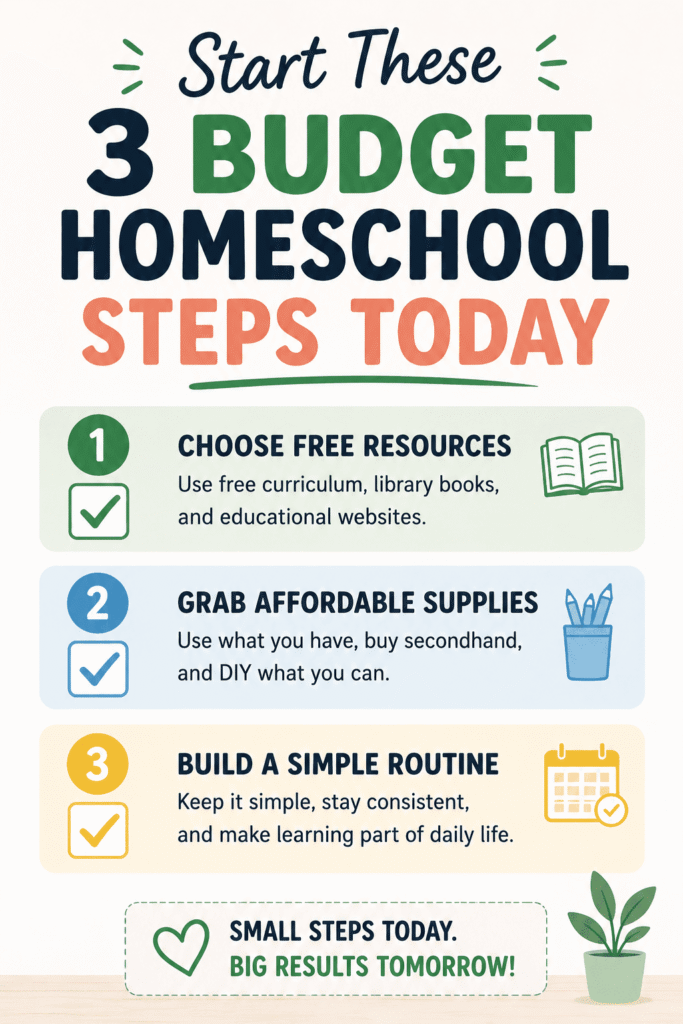
Step 1: Choose Free Core Curriculum
Use platforms like Khan Academy or Easy Peasy for math, science, and core subjects.
Step 2: Use the Library for Reading
Borrow books instead of buying them. Rotate weekly to keep learning fresh.
Step 3: Add One or Two Learning Apps
Use free apps for practice in math, reading, or language.
Step 4: Include Hands-On Learning
Use DIY materials for science, art, and activities.
Step 5: Use Real-Life Learning Daily
Add cooking, shopping, and nature walks as part of education.
This simple system helps families build a complete homeschool plan without overspending.
What are the best free homeschool curriculum options?
Some of the top free curriculum options include Khan Academy for core subjects, CK-12 for interactive lessons, Easy Peasy All-in-One Homeschool, Ambleside Online, and various Open Educational Resources (OER) available online.
How can I homeschool on a tight budget?
Use free curriculum, thrifted books, DIY learning tools, printable worksheets, and free educational apps. Joining co-ops or local groups can also help share materials and save money.
Where can I find free learning resources online?
Websites like Project Gutenberg, NASA for Students, National Geographic Kids, and Smithsonian Learning Lab offer thousands of free books, projects, videos, and worksheets.
Are there cheap science or math tools for homeschoolers?
Yes, you can use household items for experiments, printable manipulatives, thrifted math kits, flashcards, or low-cost counters and blocks for hands-on learning.
Can libraries help with homeschooling?
Absolutely. Libraries offer free books, educational kits, online resources, storytime sessions, and sometimes free workshops, making them a great frugal homeschooling resource.
How do I find budget-friendly homeschool communities?
Look for local co-ops, Facebook groups, and neighborhood networks where families exchange materials or organize free activities. Online forums for homeschoolers also provide tips and free resources.
How can I track which resources work best for my child?
Monitor engagement, progress, and interest. Note which worksheets, apps, or activities your child enjoys and learns from. Adjust your resource mix accordingly to stay cost-effective and effective.
Final Takeaway
Frugal homeschool ideas show that homeschooling does not have to be expensive to be effective. Many families successfully teach their children using free homeschool curriculum, library resources, cheap learning materials, and simple DIY tools.
The key is focusing on learning rather than buying more supplies. Free educational websites, used books, community resources, and real-life learning activities can provide a strong education without high costs.
Start small. Choose a few frugal homeschool ideas from this list and build your routine around them. Over time, you will discover that many of the best homeschool resources cost little or nothing.
A simple, resourceful approach can make homeschooling both affordable and highly effective.