
Last Updated on March 4, 2026 by Gil
Weekends are supposed to feel relaxing. But for many families, they’re the most expensive part of the week. A quick dinner out turns into $80. A small Target run becomes $150. Add coffee stops, kids asking for treats, and one “why not” purchase, and your budget is off track by Sunday night.
This is how money quietly disappears.
The problem isn’t income. It’s unplanned weekend spending. When there’s free time, there’s more temptation. More scrolling. More outings. More impulse decisions.
That’s where a no-spend weekend changes everything.
This isn’t about being cheap. It’s about hitting reset. For 48 hours, you pause unnecessary spending and focus on using what you already have. You slow down. You become aware. And you keep your money where it belongs.
Done right, one or two no-spend weekends a month can save hundreds. Over a year, that can mean thousands back in your pocket. That’s real progress toward an emergency fund, debt freedom, or simply less financial stress.
This isn’t just a list of random ideas. It’s a complete family system. You’ll learn how to plan it, how to enjoy it, how to avoid common mistakes, and how to turn it into a habit that actually builds savings.
If weekends are draining your wallet, this is where that stops.
What Is a No-Spend Weekend (And What It Is Not)
A no-spend weekend means no unnecessary spending for 48 hours. No eating out. No shopping. No impulse buys. You use what you already have.
Essentials are fine. Emergencies are fine. Extras are not.
This isn’t about being cheap. It’s about stopping automatic weekend spending. Most money disappears on small, unplanned decisions. A no-spend weekend interrupts that pattern.

Keep the rules simple:
No restaurants.
No coffee runs.
No online browsing.
No “quick” store trips.
Decide the rules before the weekend starts. If you wait until you’re bored or tired, you’ll spend.
How Much Money Can You Save With a No-Spend Weekend?
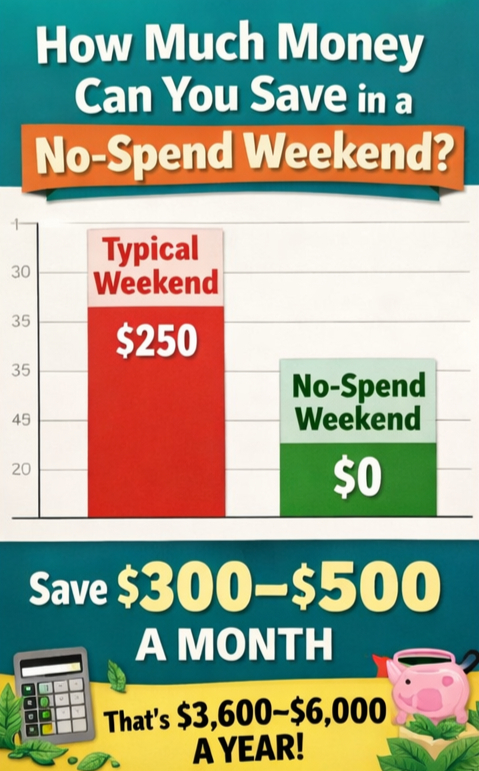
A typical family spends between $150 and $250 on weekend extras like dining out, entertainment, coffee runs, and impulse shopping. Cutting just two weekends per month can save $300 to $500. Over a year, that adds up to $3,600 to $6,000 in real savings.
That money can fund an emergency fund, pay off debt faster, or reduce monthly financial stress.
Why Most People Fail a No-Spend Weekend
Most people fail because they don’t plan ahead. Boredom, cravings, social pressure, and last-minute decisions lead to spending. If food isn’t prepared or activities aren’t planned, the easiest option becomes takeout or shopping.
Success comes down to one thing: remove spending triggers before the weekend starts. When you plan ahead, the temptation drops and staying on track becomes simple.
The No-Spend Weekend Plan (Step-by-Step)
- Pick your weekend in advance and commit.
- Plan free activities for both days.
- Prep all meals and snacks before it starts.
- Remove spending triggers like shopping apps and email deals.
- Tell your family the plan so expectations are clear.
- Track how much you didn’t spend.
When you prepare before Friday night, the weekend becomes easy. Most failures happen because people try to “wing it.” Plan first. Spend less.
35 No-Spend Weekend Ideas That Actually Save Money
Use this list to plan your weekend in advance. Pick 3–5 ideas so you’re never bored and never tempted to spend.
- Backyard picnic with food you already have.
- Family movie night using streaming you already pay for.
- Board game tournament with simple prizes from home.
- Nature walk or local park visit.
- Bike ride around your neighborhood.
- Cook a new recipe using pantry ingredients only.
- Declutter one room and organize it fully.
- Deep clean and reset your home.
- Library visit for free books and movies.
- DIY spa night at home.
- Home workout challenge.
- Start a reading marathon.
- Create a family scavenger hunt.
- Build a backyard obstacle course.
- Have a no-cost date night at home.
- Try a free YouTube cooking or fitness class.
- Start a small garden using what you have.
- Rearrange furniture for a fresh space.
- Host a potluck with friends at home.
- Make homemade pizza or dessert night.
- Have a digital detox day.
- Journal and plan your financial goals.
- Review and organize your monthly budget.
- Teach kids basic money lessons at home.
- Repair something instead of replacing it.
- Sort clothes and create donation piles.
- Plan next week’s meals from pantry items.
- Create vision boards from old magazines.
- Do a puzzle marathon.
- Watch free documentaries.
- Try a 24-hour social media break.
- Practice a new skill online for free.
- Host a storytelling night with kids.
- Plan upcoming financial goals together.
- Calculate how much you saved and move it to savings.
The key is simple: stay busy with intention. When your time is planned, your money stays untouched.
How to Do a No-Spend Weekend Without Feeling Deprived
If it feels like punishment, you won’t repeat it. The goal is not restriction. The goal is reset.
Focus on what you can do, not what you can’t buy. Most of the best weekends don’t require money. They require time and attention.
Change the language in your home. Don’t say, “We can’t afford that.” Say, “We’re choosing to save this weekend.” That small shift removes scarcity and builds control.
Plan simple rewards that cost nothing. A special breakfast at home. A family movie night. A long walk together. When the weekend feels intentional, it doesn’t feel limiting.
And at the end, move the money you didn’t spend into savings. Seeing real progress makes the habit easier next time.
How to Turn No-Spend Weekends Into a Monthly Habit
One weekend won’t change your finances. Repeating it will.
Start with one no-spend weekend per month. Put it on your calendar like an appointment. When it’s scheduled, it becomes normal instead of optional.
Match it with your paycheck cycle. Many families overspend right after getting paid. Placing a no-spend weekend there protects your money before it disappears.
Give your savings a job. Move the amount you didn’t spend into a separate account for debt payoff, an emergency fund, or a sinking fund. When saved money has a purpose, motivation increases.
Avoid rebound spending on Monday. Don’t “reward” yourself for saving. That cancels the progress.
Keep it simple. Schedule it. Plan it. Repeat it. Small habits done monthly build serious savings over time.
How No-Spend Weekends Help You Fight Lifestyle Inflation
Lifestyle inflation happens when spending rises every time income rises. You earn more, but your bank account doesn’t grow. Weekends are where this shows up first. Better income often means more dining out, more shopping, and more paid entertainment.
A no-spend weekend protects you from that pattern. It reminds you that fun does not require spending. It builds discipline before expenses become permanent habits.
When you practice spending less on weekends, you lower your “normal.” That gap between what you earn and what you spend starts to widen. That gap is where savings grow.
Over time, this small habit trains you to question upgrades, impulse buys, and reward spending. And that shift is what builds long-term financial stability.
Real-Life Examples: What This Looks Like in Practice
A family of four normally spends about $200 every weekend on restaurants, snacks, and small outings. They switch to two no-spend weekends per month. That keeps $400 in their account. In one year, they build nearly $5,000 toward their emergency fund without changing income.
A single adult who spends $120 on food delivery, coffee, and random purchases each weekend cuts that in half with two no-spend weekends. That’s about $240 saved monthly. In twelve months, that’s almost $3,000 redirected to debt payoff.
Another family uses no-spend weekends to speed up credit card payments. They apply $350 monthly from skipped spending. Their balance drops faster, and interest charges shrink.
The pattern is simple. The numbers are real. Small weekend decisions create large yearly results.
How do you successfully complete a no-spend weekend without cheating?
To complete a no-spend weekend successfully, plan meals ahead of time, schedule free activities, and remove spending triggers like shopping apps and marketing emails. Clear rules and preparation prevent impulse purchases and make it easier to avoid dining out, online shopping, and unnecessary spending.
What are the best no-spend weekend ideas for families with kids?
The best no-spend weekend ideas for families include backyard picnics, library visits, board game tournaments, scavenger hunts, movie nights at home, and local park trips. Structured free activities keep kids engaged and reduce pressure to spend on paid entertainment.
Can a no-spend weekend help pay off debt faster?
Yes. A typical family spends $150–$250 on weekend extras. Redirecting that amount toward credit card payments or loans can significantly reduce interest and shorten repayment time. Two no-spend weekends per month can accelerate debt payoff without changing income.
How much money can the average household save with no-spend weekends?
Most households spend $150–$300 on restaurants, coffee, shopping, and entertainment each weekend. Cutting two weekends per month can save $300–$500, adding up to $3,600–$6,000 per year in potential savings.
What counts as breaking a no-spend weekend?
Purchasing non-essential items such as takeout, new clothing, online orders, paid events, or impulse store purchases counts as breaking the challenge. Essential expenses like emergencies or pre-planned bills do not.
Are no-spend weekends realistic long term?
Yes, when done consistently but moderately. Most families succeed by scheduling one or two no-spend weekends per month. Planning ahead and assigning the saved money to specific goals makes the habit sustainable and effective.
Final Thoughts: Why This Simple Habit Changes Your Finances
No-spend weekends work because they force awareness. They interrupt automatic spending and give your budget breathing room. Most families don’t have an income problem. They have a weekend spending problem.
Cutting just two weekends per month can free up hundreds of dollars. Over a year, that becomes thousands. That’s emergency fund money. That’s debt payoff momentum. That’s less stress at the end of every month.
And the best part? You don’t need to earn more. You just need to pause spending.
Start with one weekend this month. Plan it. Commit to it. Move the money you didn’t spend into savings immediately. Then repeat it next month.
Small weekend decisions create big financial results.








3 thoughts on “35 No-Spend Weekend Ideas That Actually Save Money (Complete Family Guide)”
What’s up to all, the contents existing at this site are genuinely remarkable for
people knowledge, well, keep up the good work fellows.
Hi there! I could have sworn I’ve been to this website before but after reading through some of the post
I realized it’s new to me. Anyways, I’m definitely
glad I found it and I’ll be bookmarking and checking back frequently!
Quality posts is the important to interest the viewers to pay a quick visit the web page, that’s what this web site is providing.