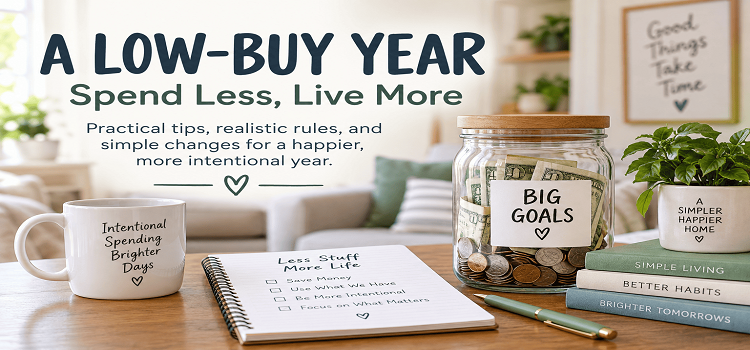
Low-buy year rules and ideas can help your family spend less without making everyday life feel restrictive. Instead of banning every purchase, a low-buy year sets clear limits on what you can buy, what you should avoid, and when spending is actually worth it. This makes it easier to cut impulse purchases, use what you already own, and put more money toward savings, debt, or family goals. The best part is that you can create rules that fit your household instead of following an extreme no-spend plan. Below, you’ll learn practical low-buy rules, realistic exceptions, and simple ideas that make the challenge easier to stick with all year.
What Is a Low-Buy Year?
A low-buy year is a 12-month spending challenge where you intentionally limit nonessential purchases while still allowing necessary expenses and a few planned wants. Unlike a strict no-buy year, the goal is not to stop spending completely. It is to create clear buying rules that reduce waste, impulse shopping, and unnecessary spending.
A low-buy year works well for families because it can be adjusted around real household needs. You can still pay for groceries, school supplies, medical costs, kids’ clothing, home repairs, and planned family experiences.
The challenge mainly targets the purchases that quietly drain your budget.
These often include:
- Impulse buys
- Extra clothing and shoes
- Home décor
- Unused subscriptions
- Takeout and convenience spending
- Beauty products you already have
- Duplicate household items
- Shopping triggered by sales
- Random online purchases
Low-Buy Year vs. No-Buy Year
A no-buy year usually has stricter rules and eliminates most nonessential purchases. A low-buy year gives you more flexibility.
For example, instead of saying, “I cannot buy clothes this year,” your rule might be:
“I will only replace clothing that is worn out or no longer fits.”
That small difference can make a low-buy challenge easier for families to maintain for the full year.
The goal is not deprivation. It is learning to spend with intention and making sure your money goes toward things your family actually values.
27 Low-Buy Year Rules That Actually Work
The best low-buy year rules set clear limits before you are tempted to spend. Your rules should control impulse purchases without making normal family life difficult. Start with the areas where you overspend most, decide what counts as an exception, and make every unnecessary purchase require more thought.
Best Low-Buy Rules for Everyday Spending
- Buy replacements, not extras
Only replace something when the item you already own is worn out, broken, empty, or no longer usable.
- Use what you already have first
Check your pantry, freezer, closet, bathroom cabinets, and storage areas before buying anything new.
- Follow a 72-hour waiting rule
Wait at least three days before making an unplanned nonessential purchase. Many things you think you need will stop feeling important after a few days.
- Keep a shopping wish list
Instead of buying something immediately, add it to a list. Review the list once or twice each month and remove anything you no longer want.
- Do not shop for entertainment
Avoid browsing stores, shopping apps, and online marketplaces when you are bored. Shopping without a clear purpose makes impulse spending much harder to control.
- Unsubscribe from promotional emails
Remove store emails, sale alerts, text promotions, and shopping notifications that constantly encourage you to spend.
- Remove saved payment information
Delete stored credit card details from shopping websites. The extra step of entering your information gives you another chance to reconsider the purchase.
- Set a monthly fun-money limit
Give yourself a small amount for personal wants rather than banning everything. Once that money is gone, wait until the next month.
- Avoid buying something just because it is on sale
A discount does not save money if you would not have bought the item otherwise.
- Finish products before replacing them
Use up toiletries, cleaning supplies, makeup, pantry foods, and similar products before opening or purchasing another version.
Low-Buy Clothing and Household Rules
- Replace clothing only when necessary
Buy clothes when something wears out, children outgrow an essential item, or there is a genuine gap in the wardrobe.
- Create a one-in, one-out rule
When you buy a new nonessential item, remove or donate something similar that you already own.
- Avoid seasonal décor purchases
Reuse decorations from previous years instead of buying new items for every holiday or season.
- Borrow before buying
Borrow tools, books, party supplies, equipment, and rarely used household items when possible.
- Repair before replacing
Try fixing clothing, furniture, appliances, toys, and household items before assuming you need a new one.
- Buy secondhand first
When you truly need something, check thrift stores, resale platforms, community groups, and local marketplaces before buying new.
- Stop buying duplicates
Do not buy another version of something simply because the color, style, or design is different.
Low-Buy Food and Family Rules
- Limit restaurant and takeout spending
Choose a realistic monthly limit for eating out rather than ordering food whenever cooking feels inconvenient.
- Plan meals before grocery shopping
Create a simple meal plan around food your family already has before writing the grocery list.
- Shop groceries with a list
Avoid adding random snacks, drinks, or sale items unless they replace something already planned.
- Use leftovers before cooking another meal
Schedule leftover nights so food does not get forgotten in the refrigerator.
- Choose free family activities first
Use parks, libraries, hiking trails, movie nights at home, free community events, and other low-cost activities before paying for entertainment.
Low-Buy Rules for Bigger Purchases
- Wait 30 days before expensive wants
For larger nonessential purchases, use a 30-day waiting period. This separates genuine needs from short-term excitement.
- Set a spending threshold
Choose an amount, such as $50 or $100, that requires extra discussion before either adult in the household makes the purchase.
- Save for wants before buying them
Do not use debt or buy-now-pay-later plans for optional purchases. Put money aside until you can comfortably afford the item.
- Create clear exceptions before the year starts
Write down what you are allowed to buy, such as medical needs, replacement shoes, school supplies, gifts, home repairs, or planned travel.
- Track every nonessential purchase
Keep a simple record of what you bought, how much it cost, and why you bought it. Seeing your spending patterns makes it easier to improve your low-buy rules as the year continues.
The goal is not to follow all 27 rules perfectly. Pick the rules that address your biggest spending problems and make them specific enough that your family knows exactly when a purchase is allowed.
Low-Buy Year Ideas for Families
The best low-buy year ideas make spending less feel practical instead of restrictive. Families can save more by replacing shopping habits with simple routines, free activities, planned purchases, and better use of what they already own. These ideas help reduce unnecessary spending while keeping everyday family life enjoyable and realistic.
Easy Low-Buy Ideas to Try This Year
- Create a use-it-up challenge
Choose one area of your home each month and focus on using what you already have.
You could start with:
- Pantry food
- Freezer meals
- Toiletries
- Cleaning products
- Craft supplies
- Kids’ snacks
- Have one no-spend weekend each month
Pick one weekend when your family avoids unnecessary spending.
Use food from home and choose free activities instead of shopping, restaurants, or paid entertainment.
- Create a family free-fun list
Write down free activities your family can choose from when everyone wants something to do.
Ideas include:
- Going to the park
- Visiting the library
- Family game nights
- Bike rides
- Hiking
- Backyard picnics
- Movie nights at home
- Free community events
- Start a pantry-first week
Once a month, plan several meals around food already sitting in your pantry, refrigerator, and freezer.
This can lower your grocery bill and reduce food waste at the same time.
- Create a clothing shopping season
Instead of buying clothes throughout the year, choose one or two planned times to review what everyone actually needs.
This works especially well for families with growing children.
- Use a replacement list
Keep a list of things that genuinely need replacing.
When you notice something wearing out, add it to the list instead of immediately buying a replacement.
This gives you time to compare prices and decide whether you truly need it.
- Try a monthly category freeze
Choose one spending category each month where you will buy nothing unless it is essential.
For example:
- January: clothing
- February: takeout
- March: home décor
- April: beauty products
- May: entertainment
Rotating categories can make the challenge easier than restricting everything at once.
- Create a borrowing list
Write down people, places, and services you can borrow from before buying something new.
Your list might include:
- Family members
- Friends
- Libraries
- Tool-lending programs
- Neighborhood groups
- Community centers
- Schedule a monthly money check-in
At the end of each month, look at what worked and what did not.
Ask:
- What unnecessary purchases did we avoid?
- Where did we overspend?
- Which rules felt too strict?
- Which rules saved the most money?
- What should we change next month?
- Redirect the money you do not spend
Saving money feels more motivating when it has a purpose.
Move part of your low-buy savings toward a specific goal, such as:
- Emergency savings
- Debt payoff
- Family vacation
- Home repairs
- School expenses
- Holiday savings
- Create a “shop your home” habit
Before buying storage bins, décor, kitchen items, toys, or supplies, check whether something you already own can solve the problem.
- Plan one intentional treat
A low-buy year does not need to remove every enjoyable purchase.
Choose one small planned treat each month so you can enjoy spending without turning it into uncontrolled shopping.
- Set a gift budget early
Birthdays and holidays can quickly break a low-buy plan.
Set gift limits before the event and consider:
- Homemade gifts
- Experiences
- Secondhand gifts
- Group gifts
- Useful gifts
- Smaller wish lists
- Keep a low-buy savings tracker
Record how much you avoided spending each month.
Even estimated savings can make progress easier to see and keep your family motivated.
- Create a family low-buy goal
Give the challenge a clear purpose.
Instead of saying, “We need to spend less,” try:
“We are doing a low-buy year so we can build a $3,000 emergency fund.”
A specific goal makes every skipped purchase feel more meaningful.
How to Start a Low-Buy Year
Starting a low-buy year works best when you create clear rules before changing your spending. Review where your money usually goes, decide what purchases are allowed, set realistic exceptions, and choose a savings goal. A simple plan makes the challenge easier to follow and reduces the chance of giving up after a few weeks.
Steps to Start Your Low-Buy Year
- Review the last three months of spending
Look through your bank and credit card statements.
Pay attention to spending on:
- Clothing
- Takeout
- Coffee
- Online shopping
- Beauty products
- Home décor
- Entertainment
- Subscriptions
- Convenience purchases
You are looking for patterns, not perfection.
- Identify your biggest spending triggers
Think about when you are most likely to buy things you did not plan to buy.
Common triggers include:
- Boredom
- Stress
- Social media
- Sales
- Influencers
- Payday
- Shopping with friends
- Late-night online browsing
Knowing your triggers makes them easier to control.
- Choose your main reason for doing a low-buy year
Give your challenge a purpose.
You might want to:
- Build an emergency fund
- Pay down debt
- Save for a vacation
- Reduce financial stress
- Stop impulse shopping
- Save for a home
- Build better spending habits
Write your goal somewhere you will see it often.
- Create your allowed spending list
Decide which purchases are always allowed.
For most families, this may include:
- Groceries
- Housing costs
- Utilities
- Medicine
- School needs
- Basic clothing replacements
- Transportation
- Home repairs
- Planned gifts
- Childcare
- Create your low-buy or restricted list
Next, decide which categories need limits.
For example:
- One takeout meal per month
- No new home décor
- No beauty products until current products are finished
- Clothing only when something needs replacing
- No impulse purchases over $25
- One paid family activity per month
The more specific your rules are, the easier they are to follow.
- Write down your exceptions
Unexpected needs will happen during a full year.
Decide in advance what counts as a reasonable exception.
Examples include:
- Emergency home repairs
- Medical needs
- Required school purchases
- Replacing broken appliances
- Necessary travel
- Unexpected children’s clothing needs
Clear exceptions prevent one necessary purchase from making you feel like the challenge has failed.
- Set your waiting periods
Use different waiting rules depending on the cost.
For example:
- Under $25: wait 72 hours
- $25 to $100: wait one week
- Over $100: wait 30 days
During the waiting period, ask whether you already own something that can do the same job.
- Create a monthly spending allowance
A small amount of personal spending money can make a low-buy year easier to maintain.
Choose an amount that fits your budget and use it for optional purchases without guilt.
Once it is gone, stop spending in that category until the next month.
- Remove easy shopping temptations
Make impulse buying less convenient.
You can:
- Delete shopping apps
- Turn off sale notifications
- Unsubscribe from retailer emails
- Unfollow shopping-focused social accounts
- Remove saved card details
- Stop browsing stores without a purpose
- Track your progress every month
At the end of each month, review your purchases and savings.
Do not only look at mistakes.
Also record:
- Purchases you avoided
- Money you saved
- Debt you paid off
- Items you used up
- Free activities your family enjoyed
- Habits that became easier
- Adjust rules that are not working
A low-buy year should challenge your spending habits, but it should still be realistic.
If one rule creates constant problems, change it instead of abandoning the entire challenge.
- Transfer your savings toward your goal
Whenever possible, move the money you save into a separate savings account or toward debt.
For example, if your family normally spends $200 a month on takeout and you reduce it to $80, move some or all of that $120 difference toward your goal.
That turns the low-buy challenge into visible financial progress.
Money-Saving Tips to Make a Low-Buy Year Easier
A successful low-buy year is easier when you reduce temptation and make saving automatic. Small systems such as meal planning, spending limits, waiting rules, and using what you already own can prevent hundreds of unnecessary purchases. The goal is to make the cheaper choice easier before the urge to spend appears.
Simple Ways to Save More During Your Low-Buy Year
✔ Set a weekly spending limit
A monthly budget can feel too broad. A weekly limit makes it easier to notice overspending before it gets out of control.
✔ Use cash for problem categories
If you overspend on takeout, entertainment, or personal purchases, try using a fixed amount of cash.
When the cash is gone, spending stops.
✔ Plan meals around what you already have
Check your pantry, freezer, and refrigerator before making a grocery list.
This reduces duplicate purchases and helps prevent food waste.
✔ Cook extra portions
Make enough dinner for lunch the next day or freeze an extra portion for a busy evening.
Having food ready makes expensive takeout less tempting.
✔ Keep easy meals at home
Not every dinner needs to be complicated.
Keep a few quick options available, such as:
- Pasta
- Eggs
- Frozen vegetables
- Sandwich ingredients
- Soup
- Rice and beans
- Freezer meals
These can help you avoid convenience spending when everyone is tired.
✔ Use a cost-per-use rule
Before buying something, think about how often you will actually use it.
A $100 item used 100 times costs about $1 per use. A $30 item used once costs $30 per use.
This simple comparison can expose purchases that look cheap but offer little value.
✔ Choose quality when replacement is unavoidable
Low-buy does not always mean buying the cheapest option.
For something your family uses regularly, a durable item may cost less over time than repeatedly replacing a poor-quality one.
✔ Keep a price list for regular purchases
Track the normal prices of groceries and household essentials you buy often.
This helps you recognize a real sale instead of buying because a store says something is discounted.
✔ Cancel subscriptions you rarely use
Review streaming services, apps, memberships, software, and subscription boxes.
Cancel anything your family has not used enough to justify the cost.
✔ Rotate subscriptions instead of keeping them all
If your family enjoys several streaming services, consider keeping one or two at a time and switching when you want different content.
✔ Use the library more
Libraries can offer much more than books.
Depending on your area, you may be able to borrow:
- Movies
- Audiobooks
- E-books
- Games
- Educational materials
- Activity kits
- Museum passes
✔ Compare before every larger purchase
When something must be replaced, compare prices from several stores instead of buying from the first place you check.
Also look at secondhand options when appropriate.
✔ Stop chasing free shipping
Adding unnecessary items to an order just to reach a free-shipping minimum can cost more than paying the shipping fee.
Compare the total cost before adding anything extra.
✔ Use rewards only for planned purchases
Cashback and rewards can be useful when they apply to something you were already going to buy.
Do not spend extra just to earn points.
✔ Plan for birthdays and holidays early
Last-minute gifts often cost more.
Keep a simple annual gift budget and save a small amount each month.
✔ Carry snacks and drinks when you leave home
A few convenience purchases can quickly turn into $20 or $30.
Keeping water and snacks with you can reduce unnecessary stops.
✔ Create a sinking fund for predictable expenses
Set aside small amounts each month for expenses you know are coming.
These might include:
- Car repairs
- School costs
- Holidays
- Birthdays
- Clothing replacements
- Home maintenance
This makes necessary spending less likely to disrupt your low-buy plan.
✔ Automate your savings
Set up an automatic transfer after payday.
Even a small automatic amount turns your low-buy year into real savings instead of leaving extra money sitting in your checking account where it can be spent.
✔ Track what you did not buy
Keep a simple list of purchases you considered but skipped.
Add up the total each month.
Seeing that you avoided $150, $300, or more in unnecessary spending can make the challenge much more motivating.
✔ Do not try to save perfectly
One unplanned purchase does not ruin a low-buy year.
Look at your spending over months, not individual days. Correct the mistake and return to your rules with the next purchase.
Why a Low-Buy Year Can Help Your Family
A low-buy year can improve more than your monthly budget. It can reduce impulse spending, simplify your home, lower financial stress, and help your family become more intentional with money. Over time, the biggest benefit is often not one large saving. It is the steady improvement in everyday spending habits.
Key Benefits of a Low-Buy Year
- You become more aware of where your money goes
A low-buy year forces you to notice the small purchases that normally disappear into your monthly spending.
A few $10, $20, or $30 purchases may not feel important on their own. But repeated every week, they can add up to hundreds or even thousands of dollars over a year.
- You can save money faster
When you reduce unnecessary spending, you create more room in your budget.
That extra money can go toward:
- Emergency savings
- Debt payoff
- Retirement
- Family travel
- Home repairs
- Education costs
- Other financial goals
- Impulse buying becomes less automatic
Waiting rules, shopping lists, and spending limits create a pause between wanting something and buying it.
That pause gives you time to decide whether the purchase is useful, necessary, or simply temporary excitement.
- Your home can become less cluttered
Buying less means fewer things enter your home.
And when you focus on using what you already own, it becomes easier to notice duplicates, forgotten items, and things your family no longer needs.
- You reduce waste
A low-buy year encourages you to finish products, eat food before it expires, repair items, and reuse what you already have.
This can reduce both household waste and unnecessary replacement costs.
- You learn the difference between wants and needs
A low-buy challenge makes you question purchases more carefully.
You may start asking:
- Do we actually need this?
- Do we own something similar?
- Can we borrow it?
- Can we repair what we have?
- Will we still want this next month?
Those questions can stay useful long after the challenge ends.
- Family spending becomes more intentional
When everyone understands the goal, money decisions can become easier.
Instead of saying “we cannot afford anything,” you can explain that your family is choosing to spend less in one area so you can spend more on something that matters more.
- Financial stress may decrease
Constant unplanned spending can make budgeting feel unpredictable.
Clear rules can make household expenses easier to manage because fewer purchases happen without planning.
- You become less influenced by sales and marketing
A sale stops feeling urgent when your rule says you only buy what you need.
Over time, phrases such as “limited time,” “must-have,” and “buy now” may have less influence over your decisions.
- Your habits can last beyond one year
The biggest advantage of a low-buy year is that it can change how you think about spending.
Even if you loosen the rules later, you may continue using waiting periods, shopping lists, replacement-only rules, and planned spending because they have become normal habits.
A low-buy year is most useful when the goal is not simply to survive 12 months of restrictions. The real value comes from building spending habits your family can keep using long after the challenge ends.
Common Low-Buy Year Mistakes to Avoid
The most common low-buy year mistakes happen when rules are too strict, exceptions are unclear, or savings are never tracked. A low-buy challenge should reduce unnecessary spending without making normal life difficult. Avoiding a few predictable problems can make it much easier to stay consistent for the full year.
Mistakes That Can Derail Your Low-Buy Challenge
- Making your rules too strict
Trying to eliminate every nonessential purchase may work for a few weeks, but it can become difficult to maintain.
A better approach is to create limits you can realistically follow for 12 months.
- Not defining your exceptions
If you do not decide what counts as an allowed purchase, you may constantly question whether you are breaking the rules.
Create exceptions before starting for things such as:
- Medical expenses
- Kids’ needs
- School supplies
- Essential clothing
- Home repairs
- Replacement appliances
- Planned gifts
- Necessary travel
- Buying everything before the challenge starts
Some people prepare for a low-buy year by stocking up on clothes, beauty products, home supplies, and other wants.
That defeats the purpose.
Start with what you already have and replace items only when needed.
- Confusing a low-buy year with a punishment
The goal is not to make your family miserable.
You can still plan affordable experiences, celebrate birthdays, enjoy occasional treats, and spend money on things that genuinely matter.
- Using sales as an excuse to buy
A 50% discount can still be 100% unnecessary.
Ask yourself whether you would buy the item at full price. If the answer is no, the sale may be creating the desire rather than solving a real need.
- Replacing shopping with another expensive habit
Cutting online shopping will not help much if the money simply moves to restaurants, coffee shops, entertainment, or another spending category.
Watch your total discretionary spending, not just one category.
- Not tracking your progress
Without tracking, it can be hard to see whether your low-buy year is actually helping.
Check your spending at least once a month and compare it with your previous habits.
- Keeping savings in your checking account
Money you do not spend can easily disappear into other purchases.
Transfer your savings toward a clear goal such as an emergency fund, debt payment, vacation fund, or major household expense.
- Comparing your rules with someone else’s
Your family may need different rules from another household.
A parent with young children, for example, may need more flexible clothing rules than someone living alone.
Build the challenge around your real life.
- Treating one mistake as failure
You may order takeout unexpectedly, buy something you did not plan for, or break one of your rules.
That does not mean the year is ruined.
Review what happened, adjust if necessary, and continue.
- Ignoring emotional spending triggers
If stress, boredom, loneliness, or social media regularly leads to shopping, simply creating a budget may not solve the problem.
Replace the shopping habit with another response, such as:
- Taking a walk
- Calling a friend
- Reading
- Exercising
- Doing something with your kids
- Waiting 24 to 72 hours before buying
- Focusing only on spending less
A low-buy year becomes easier when you know what the saved money is for.
Give every dollar you save a purpose.
When your family can see that skipped purchases are helping build savings, reduce debt, or fund an important goal, saying no to unnecessary spending becomes much easier.
What Can You Buy During a Low-Buy Year?
During a low-buy year, you can still buy necessities, replacements, planned expenses, and items that support your family’s real needs. The challenge is not about stopping all spending. It is about cutting unnecessary purchases while allowing reasonable expenses that keep your household running, safe, healthy, and comfortable.
Purchases Usually Allowed During a Low-Buy Year
- Groceries and basic household food
Food is an essential expense, but a low-buy year can still help you reduce grocery overspending.
Focus on:
- Meal planning
- Shopping with a list
- Using pantry food first
- Avoiding unnecessary convenience foods
- Reducing food waste
- Necessary clothing replacements
You can replace clothing when something is worn out, damaged, or no longer fits.
For children, this may include seasonal clothing, school clothes, coats, or shoes as they grow.
The goal is to avoid buying extra clothing simply because it is new or on sale.
- Medical and health expenses
Doctor visits, prescriptions, dental care, glasses, medical supplies, and other necessary health expenses should normally remain outside your low-buy restrictions.
Health needs should not be delayed just to maintain a spending challenge.
- School and childcare expenses
Families may need to purchase:
- School supplies
- Uniforms
- Required books
- Activity fees
- Childcare essentials
- Educational materials
Include these expenses in your planned budget instead of treating them as failures.
- Home and car repairs
Necessary repairs are usually reasonable exceptions.
Ignoring a small repair to protect your low-buy streak can sometimes lead to a much larger bill later.
- Replacement household essentials
You may need to replace something that breaks or becomes unsafe.
Examples include:
- Kitchen equipment
- Bedding
- Appliances
- Work equipment
- Basic furniture
- Safety equipment
Try repairing, borrowing, or buying secondhand before purchasing new when it makes sense.
- Planned gifts
Birthdays, holidays, weddings, and other events do not need to disappear during a low-buy year.
Set a gift budget in advance and stay within it.
- Transportation costs
Fuel, public transportation, car maintenance, insurance, and other necessary travel expenses are usually allowed.
But the challenge can still help you cut unnecessary trips or expensive convenience transportation.
- Planned family experiences
A low-buy year does not have to mean spending nothing on fun.
You might allow a limited budget for:
- Family outings
- Vacations
- Birthday experiences
- Date nights
- Special celebrations
Plan these expenses instead of making them spontaneous.
- Items that genuinely save money
Sometimes spending money now can reduce future expenses.
For example, buying reusable lunch containers may make sense if they help your family stop buying disposable bags or expensive lunches.
But calculate the real savings before using “it will save money” as a reason to shop.
Questions to Ask Before Buying Anything
Before making a purchase during your low-buy year, ask:
- Do we actually need this?
- Do we already own something that works?
- Can we repair what we have?
- Can we borrow it?
- Can we buy it secondhand?
- Can this purchase wait?
- Is it included in our rules?
- Will we use it regularly?
- Does buying it move us away from our financial goal?
If the purchase still makes sense after answering these questions, it may fit within your low-buy plan.
The point of a low-buy year is not to say no to every purchase. It is to stop spending automatically and start making each purchase more intentional.
What Should You Stop Buying During a Low-Buy Year?
During a low-buy year, the best things to stop buying are items you do not truly need, already own, or regularly purchase on impulse. The exact list will depend on your family, but cutting repeat purchases, convenience spending, duplicate products, and trend-driven shopping usually creates the biggest savings.
Common Things to Stop Buying
- Extra clothing
Avoid buying clothes just because they are inexpensive, trendy, or on sale.
Buy only when:
- Something needs replacing
- Your child has outgrown an essential item
- You need clothing for a specific purpose
- There is a genuine gap in your wardrobe
- Unnecessary home décor
Seasonal signs, decorative pillows, candles, baskets, and small home accessories can quietly become a major spending category.
Use what you already own before bringing more items into your home.
- Backup beauty products
Avoid buying shampoo, skincare, makeup, toiletries, or personal-care products while usable versions are still sitting at home.
Finish one product before replacing it.
- Duplicate kitchen gadgets
Before buying another appliance, utensil, container, or gadget, ask whether something already in your kitchen can do the same job.
- Impulse Amazon and online purchases
Small online orders can add up quickly because buying takes only a few clicks.
Add nonessential items to a wish list instead of checking out immediately.
- Random sale items
A sale is not automatically a good deal.
If an item was not needed before you saw the discount, you probably do not need it because the price dropped.
- Fast food out of convenience
Restaurant meals may still fit your rules, but ordering food simply because you did not plan dinner can become expensive.
Keep several quick meals at home for busy days.
- Daily drinks and snacks away from home
Coffee, bottled drinks, vending-machine snacks, and convenience-store purchases can feel small individually.
Preparing drinks and snacks at home can cut this spending without changing much about your routine.
- Unused subscriptions
Stop paying for memberships or subscriptions your family rarely uses.
Review:
- Streaming services
- Apps
- Software
- Subscription boxes
- Fitness memberships
- Gaming subscriptions
- Premium memberships
- Books you will probably read once
Use your local library, e-book lending services, or secondhand stores before buying every book new.
- Kids’ toys without a reason
Children do not need a constant stream of new toys.
Consider saving toy purchases for birthdays, holidays, replacements, or specific developmental needs.
- Craft and hobby supplies for future projects
Buying supplies for something you might do someday can create both clutter and wasted money.
Finish existing projects before starting another.
- Single-use convenience products
Look for reusable options when they genuinely save money.
This may include replacing repeated purchases of:
- Disposable water bottles
- Paper lunch bags
- Disposable food containers
- Single-use cleaning products
But do not replace everything at once. Use up what you already own first.
- Trendy products from social media
A product becoming popular does not mean your family needs it.
Wait several days before buying anything you discovered through social media.
- Items bought for an imaginary lifestyle
Avoid buying things for hobbies, routines, or habits you have not actually started.
Running shoes will not create a running habit. Expensive kitchen equipment will not automatically make you cook more.
Build the habit first. Buy only when the need becomes real.
- Duplicates because you cannot find what you own
Organization problems can turn into spending problems.
Before replacing something you think is missing, search your home carefully.
- Cheap items that will need replacing quickly
A low-buy year is not about choosing the cheapest product every time.
When replacement is necessary, consider durability, repairability, and how often you will use the item.
Create Your Personal “Do Not Buy” List
Every family should have its own low-buy list.
Look at your last few months of spending and identify the categories where money disappears without adding much value.
Your list might say:
- No new home décor
- No clothes unless replacing something
- No new makeup until current products are finished
- No impulse Amazon orders
- No takeout except twice per month
- No new toys outside birthdays and holidays
- No paid apps without canceling another subscription
Keep the list somewhere visible.
The clearer your low-buy year rules are, the less mental energy you need to spend deciding whether every purchase is allowed.
How to Stick to a Low-Buy Year for 12 Months
Sticking to a low-buy year becomes easier when your rules are realistic, your progress is visible, and your family knows why you are doing it. Motivation will change throughout the year, so you need simple systems that keep you on track even when the challenge feels boring, inconvenient, or difficult.
Ways to Stay Consistent With Your Low-Buy Challenge
- Keep your main goal visible
Write down why you started.
Your goal might be:
- Paying off debt
- Building emergency savings
- Saving for a family trip
- Reducing clutter
- Breaking an impulse-shopping habit
- Creating more breathing room in your budget
Put the goal somewhere you will see it often.
- Track your savings every month
Seeing progress makes the challenge feel worthwhile.
Compare your current spending with what you used to spend in areas such as:
- Clothing
- Takeout
- Online shopping
- Entertainment
- Beauty products
- Home décor
Even small monthly savings can add up over a full year.
- Celebrate milestones without overspending
Mark important points such as:
- 30 days
- 3 months
- 6 months
- 9 months
- One full year
Choose low-cost rewards like a family movie night, favorite homemade meal, picnic, or free day trip.
- Review your rules every few months
Your low-buy rules do not have to remain exactly the same all year.
If one rule is too easy, you can tighten it.
If another rule is creating unnecessary stress, make it more realistic.
The goal is consistency, not punishment.
- Use a “not buying” list
Write down items you wanted but decided not to purchase.
Include the price next to each one.
At the end of the month, total the amount.
You may be surprised by how much money stayed in your account simply because you waited.
- Find replacements for shopping habits
If shopping is one of your main forms of entertainment, you need something else to do.
Try:
- Walking
- Reading
- Organizing
- Baking
- Exercising
- Visiting the library
- Calling a friend
- Playing with your kids
- Working on an existing hobby
Removing shopping without replacing the habit can make the challenge harder.
- Limit exposure to temptation
Reduce the number of spending triggers you see every day.
You can:
- Unfollow shopping accounts
- Delete retailer apps
- Turn off notifications
- Stop watching shopping-haul videos
- Avoid browsing stores without a list
- Unsubscribe from promotional emails
- Talk about the goal as a family
If your household is doing the challenge together, discuss progress regularly.
Keep the conversation simple.
Ask:
- What worked this month?
- What was difficult?
- What did we enjoy without spending?
- What should we change?
This helps the challenge feel like a shared family goal rather than one person constantly saying no.
- Expect difficult months
Some months will naturally cost more than others.
Back-to-school season, holidays, travel, birthdays, home repairs, or growing children can increase spending.
A higher-spending month does not automatically mean you failed.
Look at whether the purchases were planned and necessary.
- Restart quickly after a slip
Do not wait until next month or next year to get back on track.
If you break one of your rules, review what happened and continue with the next decision.
One unnecessary purchase does not erase months of progress.
- Focus on what you gain
A low-buy year can give your family more than extra money.
You may also gain:
- Less clutter
- Fewer impulse purchases
- Better money habits
- More control over your budget
- Less financial pressure
- Greater appreciation for what you already have
The challenge becomes much easier when you stop thinking only about what you are giving up and start noticing what your family is getting in return.
Sample Low-Buy Year Rules List You Can Copy
A low-buy year rules list should clearly define what you can buy, what you will limit, and what you will avoid for the next 12 months. Having the rules written down removes guesswork and makes spending decisions faster. Use this sample as a starting point and adjust it for your family’s needs.
Example Low-Buy Year Rules for a Family
- Clothing only when something needs replacing
No casual clothing shopping. New clothes are allowed when an essential item wears out, no longer fits, or is needed for work, school, weather, or a specific event.
- No new home décor
Use decorations, furniture, baskets, pillows, and seasonal items already in the house.
Exceptions can be made for something needed after a move or necessary home repair.
- Use up beauty and personal-care products first
Do not buy another shampoo, lotion, makeup product, skincare item, or similar product until the current one is finished.
- No impulse online purchases
Anything that was not planned must go on a wish list first.
Wait at least 72 hours before purchases under $100 and 30 days before larger wants.
- Takeout is limited
Set a rule such as:
- Two takeout meals per month
- One restaurant meal per month
- Restaurants only for planned celebrations
Choose a limit that fits your family budget.
- Groceries require a list
Check the pantry, refrigerator, and freezer before shopping.
Only buy items needed for the meal plan, household staples, and reasonable treats already included in the budget.
- No duplicate household products
Do not buy another kitchen gadget, storage item, cleaning product, tool, or household item if something at home can already do the job.
- Kids’ toys are limited to planned occasions
New toys are reserved for birthdays, holidays, earned rewards, or a genuine developmental need.
Use toy rotations, libraries, swaps, and secondhand options during the rest of the year.
- Books come from the library first
Borrow books before buying them.
Purchase a book only when you expect to reread it, use it regularly, or cannot reasonably borrow it.
- No new hobby supplies until current supplies are used
Finish existing craft projects, puzzles, games, art supplies, or hobby materials before purchasing more.
- Subscriptions must earn their place
Cancel memberships and subscriptions that are rarely used.
If you want to add a new entertainment subscription, cancel or pause another one first.
- Repair before replacing
Try to fix damaged clothing, furniture, toys, electronics, appliances, and household items when repair makes financial sense.
- Check secondhand options first
For necessary purchases, check thrift stores, resale sites, local groups, and used options before automatically buying new.
- No shopping because of a sale
A discount does not make an unnecessary purchase necessary.
Only buy sale items already included on your planned shopping list.
- Use free entertainment before paid entertainment
Start with parks, libraries, home movie nights, hikes, community events, game nights, and other free activities.
Keep paid outings within a set monthly budget.
- Gifts have a fixed budget
Decide how much you will spend on birthdays, holidays, weddings, and other occasions before shopping.
Do not increase the budget simply because you find more gift ideas.
- Large purchases require family discussion
Choose a threshold that fits your household.
For example, any optional purchase over $100 must be discussed before money is spent.
- No buy-now-pay-later for wants
Optional purchases must be paid for with money already available.
If you cannot comfortably pay for the item now, save for it instead.
- One planned personal treat is allowed each month
A small allowance can prevent the challenge from feeling too restrictive.
Choose the amount before the month begins and stay within it.
- Track every nonessential purchase
Write down what you bought, the cost, and whether it followed your rules.
Review the list at the end of each month.
Simple Low-Buy Year Rule to Remember
When you are unsure about a purchase, use this order:
Use it → repair it → borrow it → buy it secondhand → buy it new.
You do not need identical rules for every household member. The strongest low-buy plan is one that targets your family’s actual spending habits while leaving enough flexibility to handle real life.
What are the rules for a low-buy year?
Low-buy year rules usually limit nonessential purchases such as clothing, home décor, takeout, beauty products, entertainment, and impulse shopping. Essential expenses remain allowed. Most people also use waiting periods, replacement-only rules, monthly spending limits, and written exceptions for necessary family purchases.
What is the difference between a low-buy year and a no-buy year?
A low-buy year allows limited and intentional nonessential spending, while a no-buy year usually removes most optional purchases completely. Low-buy challenges are generally more flexible, making them easier for families who need to handle changing clothing sizes, school costs, celebrations, home repairs, and other unpredictable expenses.
How do I plan a low-buy year?
Start by reviewing your recent spending and identifying the categories where you overspend most. Then create three lists: purchases that are allowed, purchases that are restricted, and purchases you will avoid. Add clear exceptions, set waiting periods, choose a savings goal, and review your progress monthly.
How long should a low-buy challenge last?
A low-buy challenge can last one month, three months, six months, or a full year. A 12-month challenge gives you enough time to experience birthdays, holidays, vacations, seasonal expenses, and other spending triggers. Beginners can start with 30 days before committing to an entire year.
How much money can you save with a low-buy year?
How much you save depends on how much unnecessary spending you currently have. A family that cuts $250 in optional spending each month could keep about $3,000 over one year. Someone cutting $500 monthly could redirect about $6,000 toward savings, debt, or another financial goal.
Can you buy clothes during a low-buy year?
Yes. Most low-buy plans allow clothing when an item genuinely needs replacing or when a child has outgrown essential clothes. You can make the rule stricter by shopping secondhand first, limiting purchases to specific seasons, or following a replacement-only clothing rule.
Can you eat out during a low-buy year?
Yes, if restaurant spending is included in your rules. Instead of banning it completely, you could allow one or two restaurant meals per month, set a fixed dining budget, or reserve eating out for birthdays and special occasions. Planned spending is different from repeated convenience purchases.
What happens if I break my low-buy rules?
One purchase does not mean your low-buy year has failed. Identify why the purchase happened, decide whether your rules need adjusting, and continue with your next spending decision. Avoid the idea that one mistake gives you permission to abandon months of progress.
Is a low-buy year worth it?
A low-buy year can be worth it if unnecessary spending is keeping you from reaching financial goals. Besides saving money, it can help you reduce clutter, recognize impulse-shopping triggers, waste less, use what you own, and become more intentional about where your family’s money goes.
When is the best time to start a low-buy year?
You can start a low-buy year at any time. January is popular because it creates a clear 12-month timeline, but waiting for a new year is unnecessary. Starting at the beginning of any month makes tracking easier. The best time is when you are ready to create realistic rules and follow them consistently.
Is a Low-Buy Year Right for Your Family?
A low-buy year can help your family spend less, save more, and build better money habits without cutting out everything you enjoy. The key is to create realistic rules, allow necessary expenses, track your progress, and focus on the purchases that matter most instead of trying to be perfect.
You do not need to follow every rule in this guide.
Start with the spending categories causing the most problems in your budget. Pick a few rules, write down your exceptions, and choose one clear savings goal.
Then give it a full month.
If the system works, keep going. If something feels too strict, adjust it without quitting.
A successful low-buy year is not about buying nothing. It is about making sure more of your money goes toward the things your family actually values.
Choose three low-buy rules from this guide and start using them this week. And if you are trying a low-buy year, share the rule that will be hardest for your family to follow in the comments.