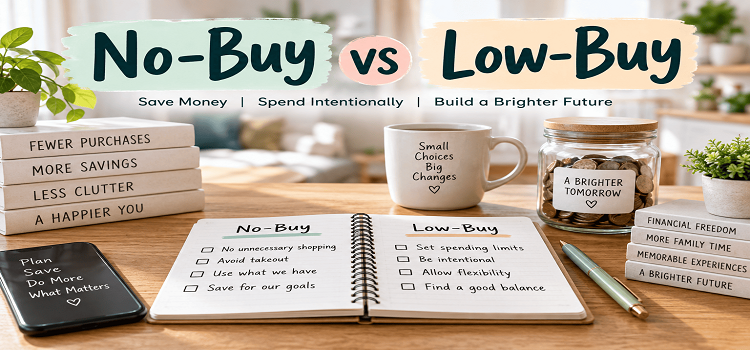
No-Buy vs Low-Buy is a simple comparison that can help families decide how strict they want to be with spending. A no-buy challenge cuts out most nonessential purchases for a set period, while a low-buy challenge allows some spending under clear rules. Both can help reduce impulse buying, save money, and make spending more intentional. But the better choice depends on your budget, habits, goals, and family needs. In this guide, you’ll learn how no-buy and low-buy challenges work, their main differences, who each approach is best for, and how to choose a plan you can actually stick with.
What Is the Difference Between a No-Buy and Low-Buy Challenge?
A no-buy challenge means avoiding most nonessential purchases for a set period, while a low-buy challenge allows limited spending under personal rules. No-buy is stricter and works well for resetting spending habits. Low-buy offers more flexibility, making it easier for many families to follow long term.
No-Buy vs Low-Buy at a Glance
| No-Buy Challenge | Low-Buy Challenge |
|---|---|
| Stops most nonessential spending | Limits nonessential spending |
| Uses strict purchase rules | Uses flexible spending rules |
| Often lasts a week, month, or year | Can work for months or indefinitely |
| Best for a strong spending reset | Best for sustainable spending control |
| Requires more planning | Easier to adjust around family needs |
| Can produce faster short-term savings | Can be easier to maintain long term |
The biggest difference is how much flexibility you allow yourself.
With a no-buy period, you usually create a short list of things you are allowed to purchase. Essentials such as groceries, housing, utilities, medicine, transportation, and necessary household items normally stay in the budget. Clothes, takeout, entertainment, home décor, and impulse purchases may be temporarily stopped.
A low-buy period takes a softer approach. Instead of completely banning those purchases, you create limits.
For example, your family might decide to:
- Buy restaurant food only once a month.
- Replace clothes only when something is worn out.
- Set a monthly entertainment budget.
- Avoid buying new décor.
- Use existing beauty and household products before replacing them.
- Wait several days before making nonessential purchases.
Both methods encourage intentional spending. The right choice depends less on which challenge sounds harder and more on which one your family can realistically follow.
What Is a No-Buy Challenge?
A no-buy challenge is a set period when you stop buying nonessential items and spend money only on approved needs. Families often use a no-buy month or no-buy year to break impulse-spending habits, use what they already own, reduce clutter, and put more money toward important financial goals.
What Can You Buy During a No-Buy Challenge?
A no-buy challenge does not mean spending absolutely nothing. Your family still pays for necessary expenses.
Common allowed purchases include:
- Groceries and basic household supplies
- Rent or mortgage payments
- Utilities and phone bills
- Insurance
- Medicine and healthcare
- Gas or necessary transportation
- School expenses
- Childcare
- Essential repairs
- Replacement items that are genuinely needed
The goal is to stop optional spending, not make everyday family life impossible.
What Do You Stop Buying?
Your exact rules can be different, but common no-buy categories include:
- New clothes unless something essential needs replacing.
- Takeout and restaurant meals when food is available at home.
- Home décor and unnecessary household upgrades.
- Beauty products until existing products are finished.
- Books, toys, and hobby supplies you do not immediately need.
- Impulse purchases from online shopping or store trips.
- Subscription upgrades and unnecessary digital purchases.
- Entertainment spending that can be replaced with free activities.
Example of a Family No-Buy Month
Imagine a family normally spends $450 each month on takeout, clothes, entertainment, small online orders, and other nonessential purchases.
During a 30-day no-buy challenge, they decide to spend only on necessities.
They cook at home, use free family activities, wear what they already own, and postpone nonessential purchases.
If they reduce that $450 in optional spending to $100 for unavoidable exceptions, they could keep about $350 in their budget that month.
That money could go toward:
- Building an emergency fund
- Paying down credit card debt
- Catching up on bills
- Saving for a family goal
- Creating breathing room in a tight budget
A no-buy challenge works best when the rules are clear before you begin. If every purchase becomes a debate, the challenge becomes much harder to follow.
What Is a Low-Buy Challenge?
A low-buy challenge is a flexible spending plan that reduces nonessential purchases without banning them completely. Instead of stopping all optional spending, you set clear limits for categories such as clothes, dining out, entertainment, and online shopping. For many families, low-buy rules are easier to maintain for several months or longer.
How Does a Low-Buy Challenge Work?
A low-buy challenge starts with rules that match your family’s budget and weak spots.
Instead of saying, “We cannot spend anything on fun,” you might decide how much you can spend and when.
For example:
- Set a monthly eating-out limit.
Allow one restaurant meal or a fixed dollar amount each month. - Use a one-in, one-out rule for clothes.
Buy something new only when another item needs replacing. - Create a waiting period.
Wait 48 hours, seven days, or even 30 days before buying nonessential items. - Set a personal spending allowance.
Give each adult a small amount of guilt-free spending money. - Use what you already own first.
Finish toiletries, pantry food, craft supplies, and household products before buying more. - Limit online shopping.
Remove saved payment details, unsubscribe from promotional emails, and avoid browsing shopping apps for entertainment.
Example of a Family Low-Buy Month
Suppose a family normally spends $600 each month on takeout, clothes, entertainment, subscriptions, and random purchases.
Instead of cutting everything, they create a low-buy budget:
- $100 for eating out
- $50 for family entertainment
- $50 for clothing replacements
- $25 for personal treats
- No new décor or unnecessary subscriptions
Their optional spending falls from $600 to $225.
That leaves $375 available for savings, debt payments, or other family priorities.
A low-buy challenge may not feel as dramatic as a strict no-buy month, but it can be more sustainable. The goal is not to eliminate every enjoyable purchase. It is to make sure your spending reflects what matters most to your family.
No-Buy vs Low-Buy: 7 Key Differences
The main difference between no-buy vs low-buy is how much nonessential spending you allow. No-buy challenges use stricter rules and usually aim for a faster financial reset. Low-buy challenges allow controlled spending and are often easier to maintain. The best option depends on your goals, habits, budget, and family responsibilities.
1. Spending Rules
A no-buy challenge usually has firm rules. If something is not essential or included on your approved list, you do not buy it.
A low-buy challenge allows more flexibility. You can still spend in selected categories, but you create limits before you start.
For example:
- No-buy: No new clothes for 30 days.
- Low-buy: Spend no more than $50 on necessary clothing this month.
2. Level of Difficulty
No-buy challenges are usually harder because they require a bigger change in spending behavior.
You may need to say no to takeout, shopping, paid entertainment, new clothes, and other purchases all at once.
Low-buy challenges can feel easier because you still have room for occasional spending.
This flexibility may be especially useful for families with children, changing schedules, school expenses, birthdays, or unexpected needs.
3. Potential Savings
A strict no-buy period can create larger short-term savings because more spending categories are temporarily eliminated.
For example, if your family normally spends $700 each month on nonessential purchases and reduces that amount to $100, you could free up about $600.
Low-buy savings may be smaller each month, but they can add up over a longer period.
Saving $250 every month for a year would equal $3,000.
4. Length of the Challenge
No-buy challenges are often easier to manage for a defined period.
Common options include:
- No-buy weekend
- No-buy week
- No-buy month
- Three-month no-buy
- No-buy year
Low-buy challenges work well for longer periods because the rules are less restrictive.
Some families eventually turn low-buy rules into permanent spending habits instead of treating them as a temporary challenge.
5. Flexibility for Family Expenses
Family spending is not always predictable.
Children outgrow clothes. School costs appear. Cars need repairs. Birthday invitations arrive. Household items break.
A low-buy plan gives families more room to deal with these situations without feeling like they failed.
A no-buy challenge can still work, but your rules should clearly define what counts as a necessary exception.
6. Impact on Spending Habits
No-buy challenges can expose spending triggers quickly.
When you temporarily remove optional shopping, you may notice how often you buy because of:
- Boredom
- Stress
- Sales
- Social media
- Convenience
- Habit
- Fear of missing out
Low-buy challenges help you practice moderation instead.
You learn how to buy intentionally without completely avoiding every nonessential purchase.
7. Long-Term Sustainability
No-buy periods can be powerful for a financial reset, but strict rules may become difficult to maintain indefinitely.
Low-buy living is often easier to turn into a long-term lifestyle.
You can still enjoy some restaurant meals, family outings, hobbies, or personal purchases while keeping clear limits around them.
For many families, the most effective strategy is to start with a short no-buy challenge and then move into a low-buy lifestyle.
That combination can provide the strong reset of no-buy rules without requiring permanent restriction.
Which Is Better: No-Buy or Low-Buy?
A no-buy challenge is better for a short, strict spending reset, while a low-buy challenge is better for long-term spending control. No-buy can help stop impulse spending fast. Low-buy is usually easier for families because it allows necessary flexibility while still reducing unnecessary purchases and improving money habits.
Choose a No-Buy Challenge If You Need a Strong Reset
A no-buy period may work better if your spending feels out of control or you want fast results.
Consider no-buy if:
- You regularly make impulse purchases.
- Online shopping has become a habit.
- Your credit card balance keeps increasing.
- You have plenty of clothes, household items, or beauty products already.
- You want to save money quickly for a specific goal.
- You need to learn the difference between a want and a need.
- You want to see exactly where your money has been disappearing.
A short no-buy month can be especially useful after periods of heavy spending, such as the holidays, vacations, birthdays, or back-to-school season.
Choose a Low-Buy Challenge If You Need Flexibility
A low-buy plan is often better when you want to spend less without making your family budget overly restrictive.
Consider low-buy if:
- You have children with changing needs.
- Your schedule makes occasional convenience spending necessary.
- You want a plan you can follow for six months or a year.
- Strict spending bans make you want to overspend later.
- You already control most of your spending but want to improve.
- You still want room for hobbies, outings, and occasional treats.
- You prefer setting spending limits instead of banning purchases.
Low-buy rules can also work well after completing a no-buy challenge.
Which Saves More Money?
No-buy can save more money in the short term because you eliminate more purchases.
But the method that saves the most money over time is the one you can consistently follow.
Consider two examples.
Family A saves $600 during one strict no-buy month but returns to old spending habits afterward.
Family B saves $250 every month with a low-buy plan and keeps going for a year.
Family A saves:
$600
Family B saves:
$250 × 12 = $3,000
This is why stricter does not always mean better.
Consistency matters more than creating the toughest possible rules.
Can You Combine No-Buy and Low-Buy?
Yes. Combining both methods can give families the benefits of a spending reset without making strict rules permanent.
A simple approach is:
- Complete a 30-day no-buy challenge.
- Identify which purchases were easiest to stop.
- Notice which categories caused the most temptation.
- Decide which spending you genuinely missed.
- Create low-buy limits for those categories.
- Keep the no-buy rules that improved your life.
For example, you might continue buying no home décor or unnecessary subscriptions while allowing a monthly restaurant meal and a small entertainment budget.
For many families, this no-buy-to-low-buy approach creates a healthier balance between saving money and enjoying life.
How to Choose Between No-Buy and Low-Buy
To choose between no-buy and low-buy, look at your spending habits, financial goal, family needs, and how much restriction you can realistically handle. A short no-buy challenge works well for a strong reset. A low-buy plan is usually better when you need flexibility and want lasting spending changes.
Steps to Choose the Right Challenge
- Identify Your Main Money Problem
Start by asking why you want to spend less.
Maybe you are dealing with:
- Too many impulse purchases
- Growing credit card debt
- A tight monthly budget
- Too much clutter
- Frequent takeout spending
- Too many subscriptions
- Online shopping habits
- Trouble saving for emergencies
If one spending category is causing serious problems, a stricter no-buy rule may help.
If your spending is generally under control but still higher than you want, low-buy may be enough.
- Choose a Clear Financial Goal
Give the challenge a purpose.
Instead of saying, “We need to stop spending,” set a measurable goal.
For example:
- Save $1,000 for an emergency fund.
- Pay $500 extra toward debt.
- Cut optional spending by 30%.
- Stop adding purchases to a credit card.
- Save for a family vacation.
- Build a back-to-school fund.
A clear goal makes it easier to decide whether you need strict no-buy rules or flexible low-buy limits.
- Review the Last 30 Days of Spending
Look through your bank and credit card transactions.
Separate purchases into three simple groups:
- Needs
- Useful but optional purchases
- Unnecessary purchases
You may find that $10, $20, and $30 purchases are adding up faster than expected.
This spending review can also show which categories need the strongest rules.
- Consider Your Family’s Needs
A challenge should fit real life.
A parent with young children may need more flexibility than someone living alone. Growing kids may need clothes, school supplies, activity fees, or unexpected replacements.
Do not create rules that make normal family needs feel like failures.
Instead, decide what counts as an approved expense before the challenge begins.
- Think About Your Spending Personality
Strict rules work well for some people.
Others respond better to limits.
If allowing one purchase usually turns into five, a no-buy period may be easier because the answer is simply “not now.”
But if strict rules make you feel deprived and lead to rebound spending, low-buy may work better.
- Pick a Realistic Time Frame
You do not need to commit to a no-buy year on day one.
Start smaller.
You could try:
- 7-day no-buy
- 30-day no-buy
- 30-day low-buy
- 90-day low-buy
- Six-month low-buy
- One-year low-buy
A shorter challenge gives you a chance to test your rules before making a longer commitment.
- Choose the Least Restrictive Plan That Still Works
The goal is not to make spending as painful as possible.
The goal is to change your habits and save money.
If low-buy rules are enough to control your spending, there is little reason to create unnecessary restrictions.
But if you keep breaking your spending limits, a temporary no-buy period may give you the stronger reset you need.
A Simple Decision Rule
Use this quick test:
Choose no-buy if:
You need to stop a spending habit completely for a while.
Choose low-buy if:
You already have reasonable control but want to spend less.
Choose both if:
You want a short financial reset followed by a sustainable long-term plan.
For many families, that third option creates the best balance.
How to Start a No-Buy or Low-Buy Challenge
To start a no-buy or low-buy challenge, decide your goal, choose a time frame, set clear spending rules, define exceptions, and track your progress. The simpler your rules are, the easier they are to follow. Families should focus on realistic limits instead of creating a plan that feels impossible.
Steps to Start Your Challenge
- Choose One Main Goal
Start with one clear reason.
You might want to:
- Build an emergency fund.
- Pay down debt.
- Stop impulse shopping.
- Reduce clutter.
- Save for a vacation.
- Cut monthly expenses.
- Recover after a high-spending season.
Write the goal somewhere visible.
A challenge feels easier when you know what the saved money is for.
- Pick Your Challenge Length
Choose a time frame that feels realistic.
Good starting options include:
- 7 days
- 30 days
- 60 days
- 90 days
- 6 months
- 1 year
If this is your first attempt, a 30-day no-buy or low-buy challenge is usually long enough to notice your habits without feeling overwhelming.
- Create Your Allowed-Spending List
Write down the expenses that are always allowed.
For most families, this includes:
- Housing
- Utilities
- Groceries
- Insurance
- Medicine
- Transportation
- Childcare
- School expenses
- Necessary household replacements
Your list should reflect your real family needs.
- Create Your No-Buy or Limited-Buy Categories
Next, decide where you want to cut back.
Possible categories include:
- Clothing
- Takeout
- Coffee shops
- Home décor
- Toys
- Books
- Beauty products
- Hobby supplies
- Entertainment
- Online shopping
- Convenience purchases
For a no-buy challenge, you may stop these purchases completely.
For low-buy, assign a clear limit.
- Define Exceptions Before You Begin
Exceptions prevent confusion later.
For example, you might allow:
- A replacement pair of school shoes
- A birthday gift already planned
- Necessary car repairs
- Medicine
- Emergency travel
- A required work expense
Try not to create exceptions after you feel tempted to buy something.
Set them first.
- Remove Easy Spending Triggers
Make unnecessary purchases harder.
You can:
- Delete shopping apps.
- Remove saved card details.
- Unsubscribe from sales emails.
- Unfollow shopping-focused social accounts.
- Avoid browsing online stores.
- Stop visiting stores without a list.
Small barriers can give you enough time to reconsider a purchase.
- Use a Waiting Rule
A waiting period is especially useful during a low-buy challenge.
Try:
- 24 hours for small purchases.
- 7 days for medium purchases.
- 30 days for expensive nonessential purchases.
Save the item to a list instead of buying immediately.
Many wants disappear once the initial excitement passes.
- Plan Free Alternatives
Do not only focus on what you cannot buy.
Replace spending with something else.
Your family could:
- Visit a park.
- Have a movie night at home.
- Cook a favorite meal together.
- Use the library.
- Play board games.
- Take a family walk.
- Organize a picnic.
- Use crafts and supplies already at home.
This makes the challenge feel less restrictive.
- Track Every Purchase
Record what you spend during the challenge.
You can use:
- A notebook
- A spreadsheet
- A budgeting app
- Your bank account
- A simple calendar
Also track the purchases you decided not to make.
Seeing those skipped purchases add up can be motivating.
- Move the Savings Immediately
Do not leave the money sitting in your checking account where it can easily be spent later.
Move it toward your goal.
For example:
Skipped $45 takeout order → transfer $45 to savings.
This turns “not buying something” into visible progress.
- Review Your Rules Each Week
At the end of each week, ask:
- Which rules were easy?
- Which rules were difficult?
- What triggered unnecessary spending?
- Did any exception need clarification?
- How much did we save?
- What should we change next week?
Adjusting a rule is not automatically failure.
The goal is to create spending habits your family can maintain after the challenge ends.
Money-Saving Tips for a No-Buy or Low-Buy Challenge
The best way to save more during a no-buy or low-buy challenge is to remove spending triggers, plan purchases in advance, use what you already have, and give every saved dollar a purpose. Small changes can reduce unnecessary spending without making family life feel restrictive or difficult.
Best Ways to Save More During Your Challenge
- Shop Your Home First
Before buying anything, check what you already own.
Look through:
- Pantry shelves
- Freezer food
- Toiletries
- Cleaning supplies
- Kids’ clothes
- Toys and games
- Craft supplies
- Books
- Storage areas
Families often buy duplicates simply because they forget what is already available.
Using existing items first can reduce both spending and clutter.
- Plan Meals Around What You Have
Food spending can quickly weaken a no-buy or low-buy plan.
Before grocery shopping, check your refrigerator, freezer, and pantry. Build meals around ingredients that need to be used first.
Then buy only what is missing.
This simple habit can help reduce:
- Takeout
- Extra grocery trips
- Food waste
- Convenience purchases
A basic weekly meal plan can make a big difference.
- Use a Shopping List Every Time
Do not enter a store without knowing what you need.
Make a list and stick to it.
For online shopping, use the same rule. Search directly for the item you need instead of browsing deals, recommendations, and sale pages.
The longer you browse, the easier it becomes to find something you suddenly think you need.
- Avoid Shopping for Entertainment
Shopping can become something families do when they are bored.
Replace browsing stores with free activities.
Try:
- Parks
- Libraries
- Hiking
- Free community events
- Family game nights
- Movie nights at home
- Picnics
- Bike rides
- Local playgrounds
The goal is to separate entertainment from spending.
- Use Cash or a Fixed Spending Amount
If you are doing a low-buy challenge, give flexible categories a clear limit.
For example:
- $75 for restaurants
- $40 for entertainment
- $50 for clothing
- $25 for personal spending
Once the money is gone, spending in that category stops until the next month.
This creates a clear boundary without banning everything.
- Stop Chasing Sales
A discount does not save money if you were not planning to buy the item.
Instead of asking:
“Is this a good deal?”
Ask:
“Would I buy this if it were full price?”
If the answer is no, the sale probably is not helping your budget.
- Create a Wish List Instead of Buying Immediately
When you want something, write it down.
Add:
- The item
- The price
- The date you wanted it
- Why you want it
Review the list after your waiting period.
You may find that many purchases no longer seem important after a few days or weeks.
- Cancel or Pause Unused Subscriptions
Review recurring charges during your challenge.
Look for:
- Streaming services
- Apps
- Memberships
- Subscription boxes
- Software
- Gaming subscriptions
- Automatic deliveries
Even saving $10 to $20 on several monthly subscriptions can create meaningful yearly savings.
- Borrow Before You Buy
Not every item needs to be owned.
Consider borrowing from:
- Friends
- Family
- Libraries
- Community groups
- Neighbors
This works especially well for books, tools, party supplies, baby gear, and items you will only use once or twice.
- Use Free Versions First
Before paying for entertainment, apps, activities, or services, check whether a free option can meet the same need.
For example:
- Library books instead of buying books
- Free workouts instead of new fitness subscriptions
- Free local events instead of paid entertainment
- Home coffee instead of a café stop
- Free budgeting tools instead of paid apps
You do not need to remove everything enjoyable. Look for the lowest-cost way to get the same value.
- Track Your “Money Not Spent”
Keep a running total of purchases you avoided.
For example:
- Skipped takeout: $42
- Did not buy new shoes: $65
- Cancelled subscription: $15
- Used pantry food instead of extra groceries: $28
Total money not spent: $150
This makes progress easier to see.
- Give Your Savings a Job
Money saved without a purpose can easily disappear into other spending.
Decide where it will go before you begin.
You could put it toward:
- Emergency savings
- Credit card debt
- Medical expenses
- A car repair fund
- Holiday savings
- Family travel
- School costs
- A future home purchase
A specific goal turns the challenge from “we cannot buy things” into “we are choosing something more important.”
What Are the Benefits of a No-Buy or Low-Buy Challenge?
A no-buy or low-buy challenge can help families save money, reduce impulse spending, build better financial habits, and become more intentional with purchases. The biggest benefit is not simply spending less for a few weeks. It is learning which expenses truly improve your life and which ones quietly drain your budget.
1. You Can Save Money Faster
Cutting unnecessary spending creates immediate room in your budget.
Even small changes can add up.
For example, reducing:
- $120 in takeout
- $75 in impulse shopping
- $40 in subscriptions
- $65 in entertainment
could free up $300 in one month.
That money can go directly toward savings or debt.
2. You Learn Where Your Money Is Going
Many families know their major bills but underestimate smaller purchases.
Coffee runs, delivery fees, online orders, snacks, toys, and sale items can quietly consume hundreds of dollars.
A spending challenge makes these patterns easier to see.
Once you recognize them, you can decide which purchases are actually worth keeping.
3. You Reduce Impulse Buying
No-buy and low-buy rules create a pause between wanting something and purchasing it.
That pause matters.
Instead of reacting to a sale, advertisement, or social media post, you have time to ask:
- Do I really need this?
- Do I already own something similar?
- Can I borrow it?
- Can I wait?
- Is this worth delaying another financial goal?
Over time, these questions can become automatic.
4. You Can Reduce Household Clutter
Buying less means fewer things enter your home.
This can be especially helpful for families dealing with:
- Overflowing closets
- Too many toys
- Duplicate kitchen items
- Unused beauty products
- Packed storage areas
- Forgotten hobby supplies
Using what you already own first can save money while making your home easier to manage.
5. You Become More Intentional With Spending
Intentional spending means deciding where your money goes instead of spending automatically.
A no-buy challenge teaches you to pause.
A low-buy challenge teaches you to prioritize.
Both can help you spend more confidently on things that genuinely matter while saying no to purchases that add little value.
6. You Can Make Financial Goals Feel Achievable
Large savings goals can feel overwhelming.
But redirecting everyday spending makes them more manageable.
Saving an extra $200 a month would equal:
$2,400 in one year.
Saving $400 a month would equal:
$4,800 in one year.
Those amounts could make a meaningful difference toward an emergency fund, debt payoff, family trip, or major household expense.
7. You Learn to Enjoy More Without Buying More
A spending challenge can change how your family thinks about fun.
Instead of automatically connecting entertainment with shopping or eating out, you may start using:
- Parks
- Libraries
- Free local events
- Home movie nights
- Family walks
- Board games
- Picnics
- Existing hobbies
This does not mean never spending money again.
It means learning that enjoyment and spending do not always have to happen together.
8. You Build Habits That Can Last Beyond the Challenge
The strongest benefit appears after the challenge ends.
You may decide you no longer need certain subscriptions.
You may keep using a waiting rule.
You may continue meal planning.
You may stop browsing online stores for entertainment.
And you may keep a permanent low-buy rule for categories where you used to overspend.
That is when a temporary challenge starts becoming a long-term financial habit.
Common No-Buy and Low-Buy Mistakes to Avoid
The most common no-buy and low-buy mistakes come from making rules too strict, failing to plan for real expenses, and treating one unplanned purchase as total failure. A successful challenge needs clear boundaries, realistic exceptions, and flexibility. Avoiding these mistakes can help your family save more money and stick with the plan longer.
1. Making the Rules Too Strict
A challenge that removes every enjoyable expense can become difficult to maintain.
If your rules feel impossible from the beginning, you may quit after a few days.
Instead, focus on the spending categories causing the biggest problems.
For example, you might stop:
- Random Amazon purchases
- New clothes
- Takeout during the workweek
- Home décor
- Beauty products you already have
You do not need to eliminate every optional purchase at once.
2. Starting Without Clear Rules
“Spend less” is not a clear rule.
Decide exactly what is allowed and what is not before you begin.
For example:
Too vague: No unnecessary shopping.
Better: No new clothes, décor, beauty products, or unplanned online purchases for 30 days.
Clear rules remove the need to debate every purchase.
3. Forgetting About Real-Life Exceptions
Unexpected expenses will happen.
A child may need new shoes. Your car may need a repair. You may need medicine or a replacement household item.
These purchases do not automatically break your challenge.
Create reasonable exceptions before starting so necessary spending does not feel like failure.
4. Buying Everything Before the Challenge Starts
Avoid a large “last shopping trip” before beginning.
Stocking up on extra clothes, snacks, toiletries, or entertainment simply moves the spending to an earlier date.
Buy normal essentials.
Then begin the challenge using what you already have.
5. Using the Challenge as an Excuse to Overspend Later
A no-buy month loses much of its value if you immediately buy everything you postponed on the first day afterward.
Keep a wish list during the challenge.
At the end, review each item again.
Ask:
- Do I still want it?
- Do I need it?
- Can I afford it?
- Do I already own something similar?
- Is another financial goal more important?
Many purchases will no longer feel necessary.
6. Ignoring Small Purchases
Large purchases are easy to notice.
Small ones often escape attention.
A few dollars spent on drinks, snacks, app purchases, delivery fees, and convenience items can add up quickly.
Track those purchases too.
Your challenge should help you understand your complete spending pattern, not only major expenses.
7. Treating One Mistake as Failure
Suppose you make an unplanned $25 purchase halfway through a 30-day no-buy challenge.
That does not mean the entire month is ruined.
Do not think:
“I already failed, so I might as well start shopping again.”
Instead:
- Record the purchase.
- Identify why it happened.
- Decide how to handle the same situation next time.
- Continue the challenge immediately.
One purchase does not erase weeks of better decisions.
8. Comparing Your Rules With Someone Else’s
There is no universal no-buy or low-buy rulebook.
One person may stop buying clothes for a year. Another family may need regular clothing purchases because their children are growing.
Your challenge needs to fit:
- Your income
- Your household
- Your financial goals
- Your responsibilities
- Your spending habits
A realistic plan you follow is more useful than an extreme plan you abandon.
9. Focusing Only on What You Cannot Buy
Constantly thinking about restrictions can make the challenge feel like punishment.
Pay attention to what you are gaining instead.
That might be:
- $500 toward your emergency fund
- Less credit card debt
- A cleaner home
- Fewer impulse purchases
- Less financial stress
- More control over your money
Track those wins throughout the challenge.
10. Going Back to Old Habits When the Challenge Ends
The challenge should teach you something about your spending.
Before it finishes, decide which habits are worth keeping.
You might continue:
- The 48-hour waiting rule
- Meal planning
- Shopping with a list
- Using products before replacing them
- Limiting takeout
- Tracking nonessential spending
- Keeping certain categories low-buy
The goal is not simply to survive a no-buy month.
It is to come out of it with better spending habits than you had before.
Is no-buy better than low-buy?
No-buy is better if you need a strict reset and want to stop unnecessary spending for a short period. Low-buy is usually better for long-term use because it allows controlled spending. For many families, starting with a 30-day no-buy challenge and moving into low-buy works well.
What is the difference between no-buy and low-buy?
No-buy means avoiding most nonessential purchases for a set period. Low-buy means reducing those purchases instead of banning them completely. A no-buy plan might eliminate restaurant meals and new clothes, while a low-buy plan could allow one restaurant meal and a small clothing budget each month.
How long should a no-buy challenge last?
A no-buy challenge can last anywhere from one week to one year, but beginners may find 30 days easier to manage. A month gives you enough time to notice spending triggers and measure savings without committing to an extreme long-term restriction. You can extend the challenge later if it works.
What are typical no-buy rules?
Typical no-buy rules allow essentials such as groceries, housing, medicine, transportation, and necessary family expenses while stopping optional purchases. Common banned categories include takeout, clothing, décor, beauty products, entertainment, toys, and random online shopping. Your exact rules should match your household and financial goals.
What are good low-buy rules?
Good low-buy rules set clear limits instead of completely banning purchases. You might allow one restaurant meal per month, replace clothes only when necessary, use a 48-hour waiting rule, set a fixed entertainment budget, and finish products you already own before buying replacements.
Can you buy groceries during a no-buy month?
Yes. Groceries are normally considered an essential expense during a no-buy month. The goal is to eliminate unnecessary spending, not stop buying food. You can make the challenge more effective by meal planning, shopping your pantry first, reducing food waste, and avoiding unnecessary convenience purchases.
Can families do a no-buy year?
Yes, but a no-buy year usually works best when families create realistic exceptions for children, school expenses, medical needs, repairs, gifts, and necessary replacements. Many families also find a low-buy year easier to maintain because it allows limited spending while still reducing unnecessary purchases.
What happens if you break a no-buy challenge?
Breaking a no-buy challenge once does not mean you need to quit. Record what you bought, identify what triggered the purchase, and continue with the challenge. Treat the mistake as information. The goal is to improve your spending habits, not achieve perfect behavior for every single day.
Does a no-buy challenge actually save money?
A no-buy challenge can save money when it targets spending that would normally happen. Your savings depend on how much you usually spend on takeout, shopping, entertainment, subscriptions, and other optional purchases. Tracking money you did not spend makes it easier to measure the real impact.
Is a low-buy year worth it?
A low-buy year can be worth it if you want lasting spending changes without completely eliminating discretionary purchases. It can help reduce impulse shopping, increase savings, and make your budget more intentional. The biggest advantage is that flexible rules are often easier to follow for a full year.
Final Verdict: No-Buy vs Low-Buy—Which Is Better?
No-buy is better for a short-term spending reset, while low-buy is usually better for long-term family budgeting. A no-buy challenge can help you stop impulse spending fast. A low-buy plan gives you more flexibility and may be easier to maintain. For many families, using both methods works best.
Start with a 30-day no-buy challenge if you need stronger boundaries. Then move into a low-buy plan with realistic limits for eating out, shopping, entertainment, and other nonessential spending.
The best plan is not the strictest one. It is the one your family can actually follow.
This week, choose one spending category to make no-buy or low-buy and track how much you save. Then share what worked for your family in the comments.