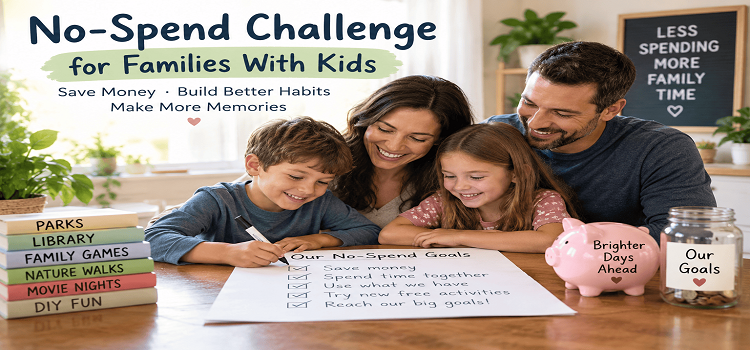
A no-spend challenge for families with kids can help you cut unnecessary spending without making family life feel boring or restrictive. The goal is simple: choose a set period of time, stop non-essential purchases, and use what you already have. But with kids, unexpected costs, snacks, activities, and small impulse buys can make the challenge harder. The right rules make a big difference. In this guide, you’ll learn how to start a realistic family no-spend challenge, what you can still buy, how to keep kids involved, and simple ways to save money while still enjoying time together.
What Is a No-Spend Challenge for Families With Kids?
A no-spend challenge for families with kids is a set period when your family avoids unnecessary purchases and spends money only on approved essentials. Families may try it for a weekend, one week, or a full month. The goal is to reduce impulse spending, use what you already own, and build better money habits together.
A family no-spend challenge is not about refusing to spend any money at all. Bills, groceries, medicine, transportation, school needs, and other necessary expenses still have to be paid.
Instead, you temporarily stop spending on things such as:
- Takeout and restaurant meals
- Coffee shop visits
- New toys
- Unplanned clothes
- Paid family entertainment
- Impulse snacks
- Online shopping
- Convenience purchases
- Extra subscriptions
- Non-essential household items
What Counts as Essential Spending?
Before starting, decide what your family is allowed to buy. Clear rules prevent arguments and make the challenge easier to follow.
Most families continue spending on essentials such as:
- Housing costs: Rent, mortgage payments, and necessary home expenses.
- Utilities: Electricity, gas, water, internet, and phone bills.
- Groceries: Basic food needed for planned family meals.
- Transportation: Fuel, public transportation, and necessary car expenses.
- Medicine and healthcare: Prescriptions, appointments, and urgent health needs.
- School essentials: Required supplies, fees, or items your child genuinely needs.
- Existing financial commitments: Insurance, debt payments, and other bills already due.
The easiest rule is this: pay for needs you already planned for, but pause optional wants.
That keeps the challenge realistic for parents while still creating enough limits to change everyday spending habits.
21 No-Spend Challenge Ideas for Families With Kids
The best no-spend challenge ideas for families with kids replace paid habits with free activities, planned meals, and things your family already owns. The challenge becomes much easier when children still have fun and parents have simple alternatives ready before the urge to spend appears.
Free Things to Do at Home
- Have a Family Movie Night
Choose a movie you already have access to, make popcorn at home, and let the kids create tickets or a pretend movie theater.
- Create a Living Room Campout
Build a blanket fort, bring out sleeping bags, tell stories, and have an indoor camping night without buying anything.
- Play Board Games
Pull forgotten games from the closet and let each family member choose one. A simple game night can replace an expensive evening out.
- Start a Family Baking Challenge
Use ingredients already in the pantry. Let kids choose a simple recipe and help measure, mix, and decorate.
- Have a Toy Swap at Home
Ask children to put away several toys for a few weeks. Bring older toys back out during the challenge so they feel new again.
- Create an Arts and Crafts Box
Use paper, cardboard boxes, old magazines, crayons, tape, and other supplies already around the house.
Free Outdoor Activities for Kids
- Visit a Local Park
Pack water and snacks from home and spend a few hours at a playground, walking trail, or open green space.
- Take a Family Nature Walk
Turn an ordinary walk into a scavenger hunt. Look for leaves, birds, flowers, interesting rocks, or different colors.
- Plan a Backyard Picnic
You do not need a restaurant to make lunch feel special. Put a blanket outside and eat the meal you would normally have indoors.
- Go on a Family Bike Ride
Use bikes, scooters, or walking shoes you already own and explore a different part of your neighborhood.
- Have a Backyard Sports Day
Create simple races, soccer games, jumping contests, or obstacle courses using items around your home.
No-Spend Food Challenges
- Eat From the Pantry
Build several meals around food already sitting in your pantry, freezer, and refrigerator before buying more groceries.
- Have a Leftover Night
Place several leftovers on the table and let everyone choose what they want. This reduces food waste and can prevent another takeout order.
- Pack Snacks Before Leaving Home
Hungry kids make convenience spending much harder to avoid. Pack fruit, crackers, sandwiches, or other snacks before errands and outings.
- Recreate a Restaurant Meal at Home
Instead of ordering pizza, burgers, pancakes, or another family favorite, make a simple homemade version together.
No-Spend Entertainment Ideas
- Use the Library
Libraries can provide books, movies, audiobooks, activities, and sometimes free children’s events without adding another purchase to your week.
- Have a Family Talent Show
Let everyone sing, dance, tell jokes, perform magic tricks, or show another skill. Kids can even make their own awards.
- Organize a Neighborhood Playdate
Invite another family over or meet at a park. Kids get entertainment while parents avoid spending money on paid attractions.
Money-Saving Family Habits
- Create a 24-Hour Buying Rule
When someone wants something unnecessary, wait at least 24 hours before making a decision. Many impulse purchases lose their appeal after a short delay.
- Keep a No-Spend Savings Jar
Each time you skip takeout, entertainment, or another unnecessary purchase, write down what you avoided spending. Watching the total grow can keep the whole family motivated.
- Let Kids Choose a Free Activity
Give children a few free options and let them decide what the family does. Giving kids some control makes a no-spend challenge feel less like punishment and more like a family project.
How to Start a No-Spend Challenge With Kids
To start a no-spend challenge with kids, choose a realistic time frame, decide what spending is allowed, explain the rules clearly, and prepare free alternatives before the challenge begins. Families are more likely to succeed when everyone understands the goal and knows what to do when the usual spending habits show up.
Step-by-Step Family No-Spend Challenge
- Choose Your Challenge Length
Start with a period your family can actually handle.
Good options include:
- One no-spend day
- A no-spend weekend
- A 7-day no-spend challenge
- Two no-spend weeks
- A full no-spend month
If your family has never tried one before, a weekend or one week is usually easier than jumping straight into 30 days.
- Pick a Clear Family Goal
Decide why you are doing the challenge.
You might want to:
- Save for an emergency fund
- Catch up on bills
- Pay down debt
- Stop impulse buying
- Reduce takeout spending
- Save for a family trip
- Reset after an expensive month
A clear goal gives everyone a reason to keep going.
- Write Your Spending Rules
Do not rely on vague rules like “we will spend less.”
Write down exactly what is allowed and what is not.
For example:
Allowed:
- Planned groceries
- Gas for work and school
- Medicine
- Bills
- Necessary school costs
Not allowed:
- Takeout
- Toys
- Extra clothes
- Paid entertainment
- Coffee runs
- Random online purchases
Clear rules remove most of the confusion.
- Check Your Calendar Before You Begin
Look for birthdays, school events, appointments, travel, sports, or other expenses that may happen during the challenge.
Planning ahead prevents one unexpected event from making the whole challenge feel like a failure.
- Check Your Pantry, Freezer, and Fridge
Make a quick inventory of the food you already have.
Then plan meals around those ingredients.
This can reduce grocery trips and help you use food that might otherwise be wasted.
- Prepare Free Activities for the Kids
Make a short list before the challenge begins.
Include easy options such as:
- Park visits
- Library trips
- Movie nights
- Crafts
- Bike rides
- Backyard games
- Playdates
- Baking
- Nature walks
The goal is to avoid deciding what to do only after the kids say, “I’m bored.”
- Remove Easy Spending Temptations
Make spending slightly harder.
You can:
- Remove saved cards from shopping apps
- Turn off shopping notifications
- Unsubscribe from sales emails
- Avoid browsing online stores
- Skip unnecessary trips to stores
- Stay off food delivery apps
Small barriers can stop many impulse purchases.
- Track What You Do Not Spend
Keep a simple note on your phone or a sheet of paper.
Write down every expense you skip.
For example:
- Takeout skipped: $35
- Coffee skipped: $12
- Toy purchase skipped: $20
- Paid activity skipped: $45
At the end of the week, add everything together.
- Talk About Progress With the Kids
Keep the conversation simple.
You do not need to make children worry about money.
Instead, explain that the family is practicing how to make smart choices and enjoy what you already have.
- Review the Challenge at the End
Ask what worked and what was difficult.
Look at:
- How much you saved
- Which spending habits caused problems
- Which free activities the kids enjoyed
- Which changes you want to keep
The best result is not a perfect no-spend streak. It is finding better habits your family can continue after the challenge ends.
Money-Saving Tips for a Family No-Spend Challenge
A successful family no-spend challenge becomes easier when you plan for the moments that normally lead to unnecessary spending. Small changes like meal planning, carrying snacks, avoiding stores, and using cash-saving rules can help families stay consistent without making the challenge feel too strict or stressful.
Simple Ways to Spend Less During the Challenge
[✔] Plan meals before the week starts. Knowing what you will cook makes takeout and last-minute grocery trips less tempting.
[✔] Shop only with a list. If groceries are allowed, buy only what your family actually needs.
[✔] Use food at home first. Check the pantry, fridge, and freezer before adding anything to your grocery list.
[✔] Carry water and snacks. This can prevent convenience-store stops when kids get hungry while you are out.
[✔] Avoid shopping for entertainment. Walking around a mall or browsing stores often leads to purchases you never planned to make.
[✔] Use free memberships and resources. Check your library, community center, parks, and school calendar for free activities.
[✔] Freeze leftovers. Saving extra portions gives you an easy meal for another busy day and reduces the urge to order food.
[✔] Pause online shopping apps. Log out or temporarily delete apps that make impulse buying too easy.
[✔] Use gift cards you already own. If your rules allow it, unused gift cards can cover an activity or purchase without taking money from your current budget.
[✔] Borrow before buying. Ask friends or family before purchasing books, tools, party supplies, sports equipment, or other short-term needs.
[✔] Combine errands. Fewer trips can reduce fuel costs and lower the chance of extra purchases.
[✔] Keep a running savings total. Seeing how much money your family has avoided spending can make the challenge feel more rewarding.
Use a “Need, Wait, or Skip” Rule
Before buying anything during the challenge, place it into one of three categories:
- Need: Your family genuinely needs it now.
- Wait: It may be useful, but it can wait until the challenge ends.
- Skip: It is an impulse purchase or something you can live without.
This simple rule helps parents make faster decisions without debating every purchase.
Give Yourself a Small Emergency Exception
A no-spend challenge should never stop you from handling a genuine family need.
Unexpected medicine, a necessary school item, an urgent repair, or another essential expense does not mean you failed.
The goal is to stop unnecessary spending, not necessary spending.
When an unexpected cost comes up, pay for what your family needs, record it, and continue the challenge instead of giving up completely.
Why a No-Spend Challenge Can Help Your Family
A no-spend challenge can help families save money, reduce impulse purchases, use what they already own, and become more aware of everyday spending habits. It also gives parents a practical way to teach children that having fun does not always require spending money.
Benefits of Doing a No-Spend Challenge With Kids
- You See Where Your Money Is Really Going
Small purchases can quietly take a large part of a family budget.
A few snacks, takeout meals, toys, and online orders may not feel expensive individually. But when you stop them for a week or month, you can see how much they were actually costing you.
- You Can Build Savings Faster
Money you normally spend on non-essential purchases can be redirected toward something more important.
That might include:
- An emergency fund
- Debt payments
- Upcoming bills
- A family vacation
- School expenses
- Home repairs
- Long-term savings
Even a short no-spend period can create extra room in your budget.
- It Helps Break Impulse-Buying Habits
A challenge forces you to wait before buying something.
That pause can help you notice which purchases come from boredom, convenience, advertising, or habit rather than a real need.
Over time, waiting before buying can become normal.
- Kids Learn Better Money Habits
Children learn a lot by watching what parents do.
When they see you compare needs and wants, wait before buying, and enjoy free activities, they begin learning basic money skills naturally.
You do not need complicated financial lessons.
Simple daily choices can teach kids that money should be used with purpose.
- Families Waste Less Food
A no-spend period encourages you to check what you already have before buying more.
That often means:
- Eating leftovers
- Using pantry staples
- Cooking frozen food
- Planning meals around ingredients at home
This can lower grocery costs while reducing food waste.
- You Find Free Ways to Have Fun
Many families spend money simply because they need something to do.
A no-spend challenge pushes you to look for alternatives.
Parks, libraries, family games, walks, crafts, picnics, and backyard activities can become regular parts of family life even after the challenge ends.
- It Can Reset Your Family Budget
If spending has slowly increased, a no-spend challenge can act as a short financial reset.
It gives you a chance to stop, review your habits, and decide which expenses are actually worth bringing back.
The Real Goal Is Better Spending, Not Zero Spending Forever
A no-spend challenge is temporary.
The goal is not to avoid spending money for the rest of your life.
The real benefit is learning which purchases improve your family’s life and which ones have become automatic.
When the challenge ends, you can bring back the expenses that matter and leave behind the ones you no longer miss.
How to Keep Kids Motivated During a No-Spend Challenge
Keeping kids motivated during a no-spend challenge works best when they feel involved instead of restricted. Explain the goal in simple terms, give them choices, celebrate progress, and replace paid activities with free ones they enjoy. The challenge should feel like a family game, not a punishment for spending money.
Ways to Make the Challenge Fun for Kids
- Let Kids Help Choose the Goal
Give children a simple reason for the challenge.
You might say the family is saving for:
- A vacation
- A fun family experience
- An emergency fund
- A special purchase
- Paying off a bill
Kids are more likely to cooperate when they understand what the family is working toward.
- Create a Family Savings Tracker
Put a simple chart on the refrigerator.
Each time your family skips an unnecessary purchase, add the amount you saved.
For example:
- Skipped fast food: $30
- Free park trip instead of paid entertainment: $40
- No toy purchase: $15
Watching the number increase gives children something visible to follow.
- Give Kids Free Choices
Instead of saying, “We cannot spend money today,” offer choices.
Ask:
“Would you rather go to the park or have a movie afternoon?”
Giving children control over free activities can prevent the challenge from feeling restrictive.
- Turn It Into a Game
Create simple family challenges such as:
- Who can find the best free activity?
- Who can create the best snack from food at home?
- Who can go the longest without asking to buy something?
- Who can find something useful that the family already owns?
Keep it light and fun.
- Celebrate No-Spend Wins
A successful day does not need a purchased reward.
Celebrate with:
- Extra story time
- Choosing the family movie
- Staying up slightly later
- A backyard picnic
- Picking dinner
- Choosing the next free family activity
This keeps rewards from defeating the purpose of the challenge.
- Avoid Making Kids Feel Guilty About Money
Children should not feel responsible for family financial stress.
Keep the message positive.
You can explain that the family is practicing smarter spending and finding new ways to have fun without buying something every time.
Adjust the Challenge for Different Ages
Young children may need more activities and simple explanations. Older kids and teenagers can understand budgeting, spending limits, and savings goals more clearly.
For younger kids:
- Use pictures or stickers on a savings chart
- Plan short free activities
- Give simple choices
For older kids:
- Let them help plan meals
- Show them how small purchases add up
- Ask them to find free entertainment
- Let them suggest expenses the family could pause
The more involved children are, the easier it becomes to turn a no-spend challenge into a family habit instead of a short-term restriction.
Common No-Spend Challenge Mistakes Families Make
The most common no-spend challenge mistakes happen when families make the rules too strict, fail to plan for real expenses, or expect everyone to adjust instantly. A successful challenge needs clear limits, realistic expectations, and room for normal family needs. Avoiding a few common mistakes can make the challenge much easier to finish.
Mistakes That Can Ruin a Family No-Spend Challenge
- Trying to Spend Absolutely Nothing
A no-spend challenge does not mean ignoring necessary expenses.
You still need to pay for things such as:
- Groceries
- Medicine
- Gas
- Bills
- School needs
- Emergency expenses
The challenge should cut optional spending, not essential spending.
- Starting Without Clear Rules
If one parent thinks takeout is allowed and the other does not, the challenge can quickly become frustrating.
Write down what counts as essential and what is temporarily paused before you begin.
- Choosing a Challenge That Is Too Long
A 30-day no-spend challenge may sound impressive, but it can be difficult for beginners.
Start smaller if needed.
A weekend or 7-day challenge can help your family learn what works before attempting a full month.
- Not Planning Meals
Food is one of the easiest places for a no-spend challenge to fall apart.
Without a meal plan, busy evenings can quickly turn into takeout orders.
Plan simple meals and keep a few easy backup options in the freezer or pantry.
- Forgetting About Upcoming Expenses
Check your calendar before starting.
A birthday party, school trip, sports fee, appointment, or family event may require spending.
Known expenses should be planned instead of treated as failures.
- Making the Challenge Too Hard on Kids
If children hear “no” all day without getting alternatives, they may quickly dislike the challenge.
Replace paid activities with free options and let kids help choose what the family does.
- Buying Extra Stuff Before the Challenge Starts
Stocking up on unnecessary snacks, entertainment, clothes, or household items before day one defeats the purpose.
Buy only what you genuinely need.
The challenge should help you use what you already have.
- Giving Up After One Purchase
One unplanned purchase does not erase the entire challenge.
Look at why it happened, adjust your plan, and continue.
A single mistake is much cheaper than abandoning the challenge and returning to normal spending.
- Not Tracking the Money You Save
If you cannot see the benefit, motivation can disappear.
Track skipped purchases and total the savings at the end.
Even small amounts can show how much everyday spending affects your budget.
- Treating the Challenge as Punishment
A no-spend challenge works better when it feels like a reset rather than a punishment.
Focus on what your family is gaining: more control, better habits, less waste, and progress toward an important financial goal.
How Long Should a Family No-Spend Challenge Last?
A family no-spend challenge can last one day, a weekend, one week, or a full month. The best length depends on your family’s spending habits, schedule, and experience. Beginners usually do better with a short challenge first, while experienced families may benefit from a longer reset.
No-Spend Weekend
A no-spend weekend is one of the easiest ways to start.
For two or three days, avoid:
- Restaurants and takeout
- Shopping trips
- Paid entertainment
- Online purchases
- Convenience snacks
- Unplanned family outings
Instead, plan free activities and eat food already at home.
A weekend challenge works well for families that often spend extra money on Saturdays and Sundays.
7-Day No-Spend Challenge
A 7-day no-spend challenge gives you enough time to notice everyday spending habits without feeling overwhelming.
During the week, focus on:
- Cooking meals at home.
- Packing lunches and snacks.
- Avoiding impulse purchases.
- Using free entertainment.
- Tracking every purchase you skip.
At the end of the week, compare what you actually spent with what you normally would have spent.
Two-Week No-Spend Challenge
Two weeks can reveal spending patterns that a weekend may miss.
You may notice that certain expenses happen because of:
- Busy workdays
- School schedules
- Weekend boredom
- Grocery habits
- Payday spending
- Online shopping
A two-week challenge gives your family time to test new routines without committing to an entire month.
30-Day No-Spend Challenge
A 30-day no-spend challenge is better for families that already understand their basic spending habits.
For one month, pause most non-essential purchases while continuing to pay normal bills and genuine necessities.
A full month can help you see how much money goes toward dining out, entertainment, shopping, and convenience.
But do not make the rules so strict that they become impossible to follow.
Which Challenge Length Is Best for Your Family?
Use your experience level as a guide:
- First-time family: Try a no-spend weekend.
- Want a stronger reset: Try seven days.
- Already comfortable spending less: Try two weeks.
- Want to seriously review your habits: Try 30 days.
You can also schedule regular no-spend days instead of doing one long challenge.
For example, your family could choose every Monday and Wednesday as no-spend days.
The best challenge is not necessarily the longest one. It is the one your family can finish and learn from.
No-Spend Challenge Rules for Families With Kids
The best no-spend challenge rules for families are simple: continue paying for genuine needs, pause non-essential purchases, use what you already have, and decide on exceptions before starting. Clear rules prevent confusion and make it easier for parents and kids to know when spending is reasonable and when it should wait.
Simple No-Spend Rules to Follow
- Pay All Normal Bills
Your mortgage, rent, utilities, insurance, debt payments, and other required bills should continue as usual.
A no-spend challenge should never cause late fees or financial problems.
- Allow Necessary Groceries
Groceries are usually an essential expense.
But the challenge is a good time to:
- Use pantry food first
- Eat freezer meals
- Plan around leftovers
- Avoid unnecessary snacks
- Skip convenience foods
- Stick closely to your grocery list
The goal is not to stop feeding your family. It is to stop wasting food and making unnecessary grocery purchases.
- Pause Restaurant and Takeout Spending
For many families, eating out is one of the biggest areas of optional spending.
During the challenge, try to avoid:
- Fast food
- Restaurant meals
- Food delivery
- Coffee shops
- Convenience-store snacks
Keep simple backup meals at home for busy days.
- Do Not Buy New Toys Unless Necessary
New toys, games, and entertainment purchases should normally wait until the challenge ends.
Encourage kids to rediscover toys, books, games, and craft supplies they already have.
- Pause Non-Essential Clothing Purchases
A required school uniform or replacement winter coat may be necessary.
Buying another shirt because it is on sale probably is not.
Use the same rule throughout the challenge: needs can stay; wants can wait.
- Avoid Paid Entertainment
Skip optional spending on:
- Movie theaters
- Arcades
- Amusement parks
- Indoor play centers
- Paid attractions
- Unplanned events
Replace them with free parks, library activities, movie nights at home, walks, playdates, and community events.
- Do Not Stock Up Just Because Something Is on Sale
A discount does not automatically make something necessary.
If you would not have bought the item without the sale, it can probably wait.
- Avoid “Buy Now, Pay Later” Purchases
Delaying the payment does not make a purchase free.
Credit cards and buy-now-pay-later services can hide how much you are actually spending during the challenge.
If an item is not essential, add it to a list and reconsider it later.
- Decide How Gift Cards Will Work
Families handle gift cards differently.
You can choose to:
- Allow existing gift cards
- Save them until the challenge ends
- Use them only for planned expenses
Choose one rule before starting so everyone understands it.
- Allow Genuine Emergencies
A broken appliance, urgent medicine, necessary car repair, or unexpected school expense may need immediate attention.
Paying for a real emergency does not break your challenge.
- Write Down Things You Want Instead of Buying Them
Create a “buy later” list.
Whenever someone wants something, write it down instead of purchasing it immediately.
At the end of the challenge, review the list.
You may be surprised how many items you no longer want.
- Never Borrow Money Just to Protect Your No-Spend Streak
The goal is better financial decisions, not a perfect record.
Never avoid an essential expense, delay an important bill, or borrow money just so you can say you completed the challenge without spending.
A successful no-spend challenge should leave your family in a better financial position than when you started.
How Much Can a Family Save With a No-Spend Challenge?
How much a family saves during a no-spend challenge depends on how often they normally spend on takeout, shopping, entertainment, snacks, and convenience purchases. Even a short challenge can reveal hundreds of dollars in optional spending that can be redirected toward savings, debt, bills, or another family goal.
Example of Potential No-Spend Savings
Here is what one week of skipped spending might look like for a typical family:
- Takeout skipped: $45
- Coffee and drinks skipped: $20
- Kids’ snacks while out: $18
- Online impulse purchase avoided: $35
- Paid family activity skipped: $60
- Extra grocery purchases avoided: $25
Total saved in one week: $203
That does not mean every family will save the same amount.
Some families may save $50 in a week. Others may save several hundred dollars, especially if they regularly spend on restaurants, entertainment, or online shopping.
What About a 30-Day No-Spend Challenge?
If your family normally spends $200 per week on optional purchases, reducing most of that spending for four weeks could keep roughly $800 in your budget.
The important part is what you do with the money afterward.
Instead of letting it disappear into normal spending, move it toward a specific goal such as:
- Building an emergency fund.
- Paying down credit card debt.
- Catching up on bills.
- Saving for school expenses.
- Building a vacation fund.
- Preparing for an upcoming large expense.
Track Avoided Spending, Not Just Money Leaving Your Account
One of the easiest ways to measure your results is to track purchases you almost made.
For example, write down:
- “Almost ordered pizza — saved $32.”
- “Skipped a store trip — saved about $40.”
- “Used free library activity — saved $25.”
- “Packed snacks — saved $14.”
These small amounts can add up faster than expected.
And seeing the total can make the challenge feel much more worthwhile for the whole family.
What to Do If You Break Your No-Spend Challenge
If you break your no-spend challenge, do not restart from day one or abandon the challenge completely. Record what you bought, identify why the purchase happened, adjust your rules if necessary, and continue. One unplanned expense does not erase the money your family has already saved or the habits you are building.
How to Get Back on Track
- Write Down the Purchase
Record what you bought and how much it cost.
Do not hide it from your tracker just because it was not planned.
For example:
- Takeout: $38
- Unplanned toy: $20
- Coffee stop: $8
Tracking the purchase helps you understand your real spending habits.
- Figure Out Why It Happened
Ask what caused the purchase.
Was your family:
- Hungry while running errands?
- Too tired to cook?
- Bored on the weekend?
- Tempted by a sale?
- Missing something important?
- Unprepared for an unexpected event?
Finding the cause is more useful than feeling guilty about the purchase.
- Fix the Problem for Next Time
Turn the mistake into a practical change.
If you ordered takeout because dinner was not planned, keep an easy freezer meal available.
If the kids asked for snacks during errands, pack snacks before leaving.
If online shopping caused the problem, remove saved payment details or temporarily delete the app.
- Do Not Use One Purchase as an Excuse to Spend More
This is one of the biggest mistakes families make.
It is easy to think:
“We already broke the challenge, so it does not matter anymore.”
But it does matter.
Spending $25 once is much better than turning that $25 mistake into a $300 weekend.
- Adjust Rules That Are Too Strict
Sometimes breaking the challenge means the rules were unrealistic.
For example, completely banning grocery spending for a month may not work for a family with growing kids.
Adjust the rule instead of abandoning the goal.
You might allow a weekly grocery budget while continuing to ban takeout, entertainment, and impulse shopping.
- Continue From the Next Decision
You do not need to wait until Monday, next month, or another challenge.
Simply make the next spending decision better.
That mindset makes a no-spend challenge more useful because it teaches recovery instead of demanding perfection.
Remember: Progress Matters More Than a Perfect Streak
A family that completes 27 successful days out of a 30-day challenge still made meaningful progress.
The purpose is not to create a perfect record.
It is to understand your spending, reduce purchases that do not matter, and build habits that keep saving your family money after the challenge is over.
What is a no-spend challenge for families?
A no-spend challenge for families is a set period when you stop spending money on non-essential purchases. You still pay bills and buy genuine necessities, but pause things like takeout, entertainment, toys, impulse shopping, and convenience purchases.
Can you buy groceries during a no-spend challenge?
Yes. Most families allow necessary groceries during a no-spend challenge. The goal is usually to reduce extra spending, not stop buying food. Try using pantry and freezer food first, planning meals, avoiding impulse grocery purchases, and sticking to a simple shopping list.
How do you do a no-spend challenge with kids?
Set clear rules, explain the goal in simple language, and prepare free activities before you begin. Let children help choose parks, movie nights, crafts, library visits, or family games. Kids are more likely to enjoy the challenge when they feel involved instead of constantly being told no.
What should you not buy during a no-spend month?
Most families pause restaurant meals, takeout, coffee runs, toys, unnecessary clothes, paid entertainment, online shopping, and other impulse purchases. Bills, groceries, medicine, transportation, and genuine family needs usually remain allowed. Decide your rules before the month starts.
How long should a no-spend challenge last?
Beginners can start with one day, a weekend, or seven days. Families that have already tried shorter challenges may choose two weeks or a full month. The best length is one that challenges your spending habits without creating unrealistic restrictions.
What happens if you need something during a no-spend challenge?
Buy it if it is a genuine need. Medicine, urgent repairs, school requirements, food, and other essential expenses should not be ignored just to protect a no-spend streak. Record the expense, decide whether it was necessary, and continue the challenge.
Is a no-spend challenge good for saving money?
Yes. A no-spend challenge can help you identify unnecessary expenses and temporarily redirect that money toward savings, debt, or bills. The biggest long-term benefit is often learning which purchases you can reduce or stop even after the challenge ends.
How can I stop spending money when my kids are bored?
Prepare a list of free activities before boredom starts. Try parks, libraries, bike rides, backyard games, crafts, baking, movie nights, nature walks, playdates, and board games. Having several options ready makes it easier to avoid paying for entertainment at the last minute.
Can a no-spend challenge include weekends?
Yes. In fact, weekends can be one of the best times to try a no-spend challenge because families often spend more on restaurants, shopping, and entertainment. Plan free outings, pack food from home, and decide on activities before the weekend begins.
Final Thoughts: Make Your No-Spend Challenge Work for Your Family
A no-spend challenge for families with kids works best when the rules are realistic, the goal is clear, and everyone has simple alternatives to spending. You do not need a perfect month. Even a few successful no-spend days can reveal waste, reduce impulse buying, and help your family keep more money.
Start small if this is your first challenge.
Choose a weekend or seven days. Write down what spending is allowed, plan meals, prepare free activities, and track every purchase you avoid.
Then decide what habits are worth keeping.
You may find that your family needs fewer takeout meals, fewer impulse purchases, and fewer paid activities than you thought.
Your action this week: Pick your no-spend dates, write your family rules, and start your first challenge.
And if you try it, share how much your family saved and which no-spend activity your kids enjoyed most.